
Stories of Hanuman
Why Is Hanuman Offered Sindoor? Why His Idols Are Orange
By the Dharmasthan team · Updated · 7 sources cited
Hanuman is offered sindoor because of a popular story: seeing Sita wear it for Rama’s long life, he covered his whole body in it. The Valmiki Ramayana and Tulsidas, who call him golden or coppery, do not tell that story; his images are orange because devotees keep coating them in sindoor and oil.
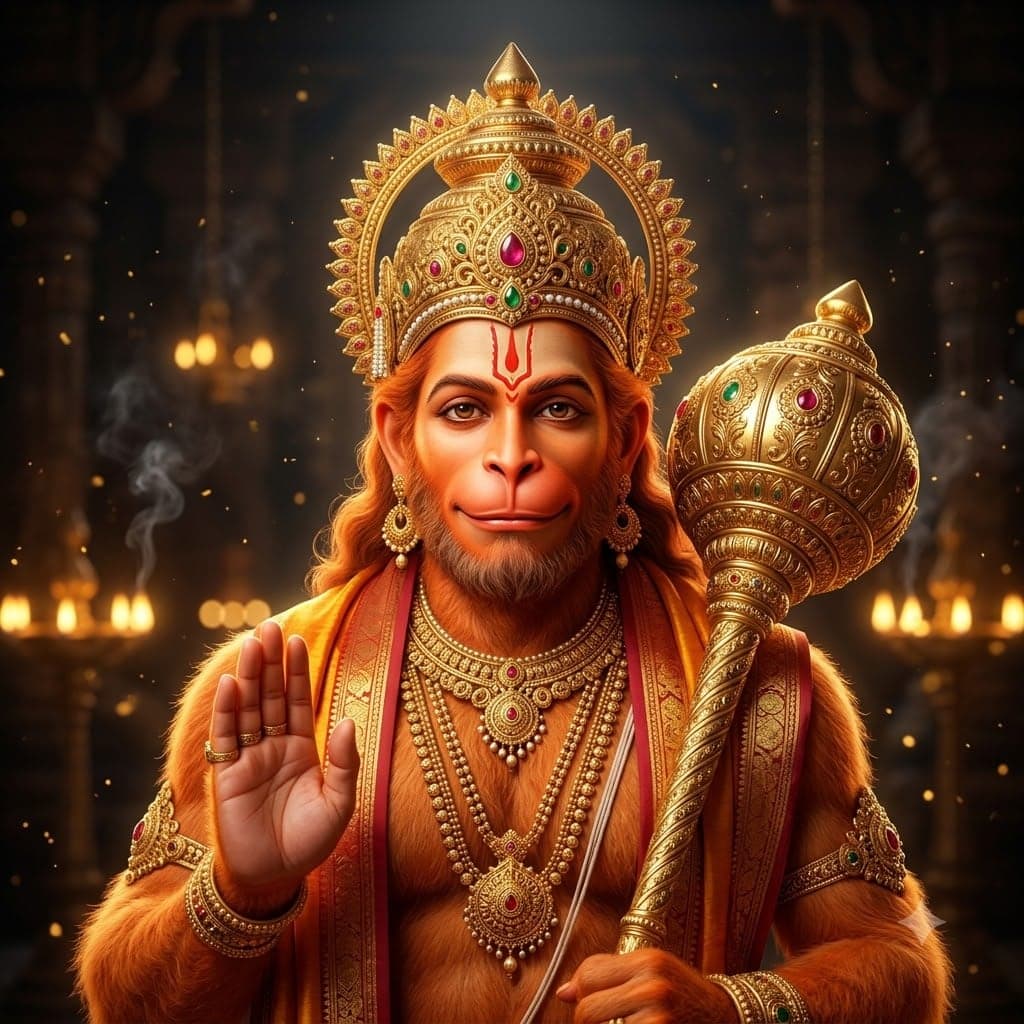
At a glance: Hanuman
- Also known as
- Maruti, Bajrangbali, Anjaneya, Pavanputra, Kesari Nandan, Sankat Mochan, Mahavir, Ramdoot, Balaji (Rajasthan)
- Family
- Son of Anjana and the vanara chief Kesari, and of the wind god Vayu (Valmiki Ramayana); the Shiva Purana calls him an incarnation of Shiva. A lifelong brahmachari in most traditions
- Shown with
- A vanara with a long tail and a mace; golden or coppery in the texts, orange with sindoor in temples; shown kneeling before Rama, carrying the herb mountain, or five-faced
- Worshipped on
- Hanuman Jayanti, on Chaitra Purnima in Maharashtra and the north (other dates in the south); Tuesday and Saturday; sindoor with oil, the Hanuman Chalisa and the Sundar Kand
- Holy places
- Anjaneri near Nashik, and Anjanadri at Hampi and at Tirumala, each held to be his birthplace; Hanumangarhi, Ayodhya; Sankat Mochan, Varanasi; Salasar and Mehandipur Balaji; Ramdas’s eleven Marutis
What colour the texts give Hanuman
The Valmiki Ramayana gives Hanuman the colours of fire and copper. As Hanuman flies over the ocean to Lanka, his reddish-brown eyes shine like the rising sun and moon, and his coppery nose makes his face glow like the sun’s disc at dusk (Sundara Kanda 5.1.59–60). His copper-red hindquarters, the poet adds, made him look like a mountain split open to show a vein of red ochre (5.1.63). When Hanuman is later paraded through Lanka with his tail on fire, the rakshasi guards tell Sita that “the red-faced monkey” is being led through the streets (5.53.25).
The Uttara Kanda gives Hanuman a golden colour at birth. Kesari, it says, ruled on Mount Sumeru, which the sun had made golden as a boon, and there his wife Anjana bore Vayu a son who shone like an ear of rice (Uttara Kanda 7.35.19–21).
Tulsidas keeps to gold. The third invocation verse of the Sundar Kand of the Ramcharitmanas hails Hanuman as “अतुलितबलधामं हेमशैलाभदेहं”, home of matchless strength, his body shining like a golden mountain (Sumeru, says the Gita Press commentary). The Hanuman Chalisa, traditionally attributed to Tulsidas, sings “कंचन बरन बिराज सुबेसा”: golden in colour and finely dressed. None of these texts says Hanuman was covered in sindoor; the orange of Hanuman’s temple images comes from what devotees put on them.
The popular story of Sita’s sindoor
The answer most devotees give is a story set in Ayodhya after Rama’s coronation, when Hanuman stayed on to serve Rama. One day Hanuman saw Sita putting sindoor in the parting of her hair and asked why. Sita said it was for her lord’s long life and well-being. Hanuman reasoned that if a pinch could do so much for Rama, a whole body covered in it would do more, and he smeared himself from head to tail. When Hanuman appeared before Rama glowing orange, Rama was delighted by such devotion. The details change from one telling to another.
The sindoor story is not in the Valmiki Ramayana or in Tulsidas’s Ramcharitmanas. Philip Lutgendorf, whose Hanuman’s Tale (Oxford University Press, 2007) is the standard study of Hanuman, retells it as “Covered with Sindur” and notes that it seems to have no premodern textual source, yet some version of it appears in nearly every collection devoted to Hanuman. Some pandits, he records, reject it as imaginary.
Devotees still love the sindoor story because it says something true about Hanuman: sindoor is a married woman’s prayer for her husband, and by wearing it all over, Hanuman makes Sita’s love for Rama his own. That is what devotees mean when they say sindoor is offered to Hanuman for Rama’s sake.
What scholars say about sindoor and oil
Coating holy stones with red is older and far wider than the story. Lutgendorf points out that hero-stones across much of India are smeared with reddish-orange sindoor, as are images of Ganesha, Hanuman, Bhairava and certain other deities, and that small sindoor-covered Hanumans sit under village peepul trees (Hanuman’s Tale, chapter 1). He describes sindoor as fragrant oil, such as sandalwood or jasmine, mixed with a red pigment: vermilion (cinnabar) or certain lead or zinc compounds.
Some scholars, such as Camille Bulcke, traced Hanuman worship to the ancient cults of yakshas, guardian spirits of villages and trees. Lutgendorf, who points to a study of how yaksha-like deities were smeared with sindoor to win their help, finds the link useful at least for placing Hanuman among the ancient folk deities.
Nineteenth-century observers saw the same custom. The Sanskritist Monier Monier-Williams, writing of Hanuman among India’s local guardian deities, noted that his images were “always smeared with vermilion (sindura) and oil” as a sign of reverence, that they were commonest in the Deccan, usually outside villages, and that in the centre of Pune he watched a man painting an old Hanuman image bright red (Religious Thought and Life in India, 1883, p. 221). The orange Hanuman belongs to this old way of honouring the protector at the village’s edge; Sita’s story gives the custom its devotional meaning.
The chola of North India and Maharashtra’s shendur
In North India the coating is called the chola, Hanuman’s “garment”: sindoor mixed with jasmine (chameli) oil is pressed over the whole image, sometimes with thin silver foil laid on top. The chola is usually offered on a Tuesday or Saturday, Hanuman’s days, and from time to time the old chola is removed and a new one applied with its own rites.
In Maharashtra, where Hanuman is Maruti, the coating is shendur with oil. A record of Konkan customs published in Bombay in 1915 says that in most villages the chief village god is Maruti, whose temple stands at the village entrance to guard it; at his Chaitra festival worshippers brought oil, shendur, a coconut and a garland of rui (calotropis) flowers, and fresh oil and shendur were offered every Saturday (Folk Lore Notes, vol. II, Konkan, chapter 2). The same notes record a local tradition that Rama, leaving the Dandaka forest, asked Maruti to stay in the land, which, people said, is why every village has its Maruti.
The Maharashtra custom goes on. The Maruti at a village’s vesh (gate) or in an old talim (wrestlers’ gymnasium) is often a rough stone glowing with layer upon layer of shendur. On Saturdays and on Hanuman Jayanti devotees offer Maruti shendur with oil, a garland of rui leaves and a coconut; the Hanuman Jayanti story describes that day.
Offering sindoor to Hanuman at home
At home, a little sindoor mixed with a few drops of oil or ghee is applied to a metal or stone image of Hanuman, or placed at the feet of a picture, with a flower or rui leaves, a lamp and the Hanuman Chalisa or Samarth Ramdas’s Maruti stotra, usually on a Tuesday or Saturday.
Traditional shendur was made from red lead (minium), as the old Bombay records describe it, so it is best handled with care and kept away from children and food. Sindoor offered to Hanuman this way is an act of devotion, not a remedy: as in Sita’s story, devotees offer it out of love for Rama.
Festivals of this story
Aartis and bhajans of Hanuman
- Hanuman Chalisa
- Hanuman Aarti
- Maine Tere Hi Bharose Hanuman (Sagar Mein Naiya Daar Dai)
- Hanuman Gayatri Mantra
- Manojavam Marutatulyavegam
- Hriday Mein Jinke Sitaram (Hanuman Ansh)
- Bajrang Baan
- Veer Hanumana Ati Balwana
Frequently asked questions
Why Is Hanuman Offered Sindoor? Why His Idols Are Orange
Hanuman is offered sindoor because of a popular story: seeing Sita wear it for Rama’s long life, he covered his whole body in it. The Valmiki Ramayana and Tulsidas, who call him golden or coppery, do not tell that story; his images are orange because devotees keep coating them in sindoor and oil.
What are the other names of Hanuman?
Maruti, Bajrangbali, Anjaneya, Pavanputra, Kesari Nandan, Sankat Mochan, Mahavir, Ramdoot, Balaji (Rajasthan)
What other stories are told about Hanuman?
Is Hanuman Still Alive? Why He Is a Chiranjivi; Where Was Hanuman Born? Anjaneri, Hampi or Tirumala; How Did Hanuman First Meet Rama? The Story at Rishyamuka; Why Did Hanuman Burn Lanka? The Story of Lanka Dahan; Why Did Hanuman Carry the Sanjeevani Mountain? The Two Flights. Each is on Dharmasthan with its sources, in English, Hindi and Marathi.
Sources
- Valmiki Ramayana, Sundara Kanda 1 (Hari Prasad Shastri tr.): Hanuman’s reddish-brown eyes, coppery nose and copper-red body like a mountain of red ochre (5.1.59–63; verse numbers from the IIT Kanpur Sanskrit text) Read the text
- Valmiki Ramayana, Sundara Kanda 53 (Hari Prasad Shastri tr.): The rakshasis call Hanuman “that red-faced monkey” (tamramukha kapi, 5.53.25) Read the text
- Valmiki Ramayana, Uttara Kanda 35 (Hari Prasad Shastri tr.): Hanuman born on golden Sumeru, his colour like an ear of rice (7.35.19–21) Read the text
- Tulsidas, Ramcharitmanas, Sundar Kand, with the Hanuman Chalisa (Gita Press, Gorakhpur, code 1349): Invocation shloka 3, “हेमशैलाभदेहं”, glossed as a body bright as golden Sumeru; the Chalisa’s “कंचन बरन बिराज सुबेसा” Read the text
- Philip Lutgendorf, Hanuman’s Tale: The Messages of a Divine Monkey (Oxford University Press, 2007), ch. 1, 4 and 5: Story 26, “Covered with Sindur”, and its lack of a premodern source; sindoor on hero-stones and on images of Ganesha, Hanuman and Bhairava; sindoor as fragrant oil and pigment; the yaksha theory
- Monier Monier-Williams, Religious Thought and Life in India, Part I (London, 1883), p. 221: Hanuman among the local guardian deities; images “always smeared with vermilion (sindura) and oil”, commonest in the Deccan; an old Hanuman painted red in Pune Read the text
- R. E. Enthoven (from A. M. T. Jackson’s materials), Folk Lore Notes, vol. II: Konkan (Bombay, 1915), ch. 2: Maruti at the village entrance; oil, red lead (shendur) and rui garlands; Saturday offerings; the tradition that Rama asked Maruti to stay Read the text