
Stories of Hanuman
Why Did Hanuman Burn Lanka? The Story of Lanka Dahan
By the Dharmasthan team · Updated · 7 sources cited
Hanuman burned Lanka because Ravana, told by Vibhishana that a messenger may not be killed, had his tail set on fire instead. In the Valmiki Ramayana Hanuman broke free and turned that fire on Ravana’s city to break the enemy’s strength, while Sita’s prayer kept the flame cool on him.
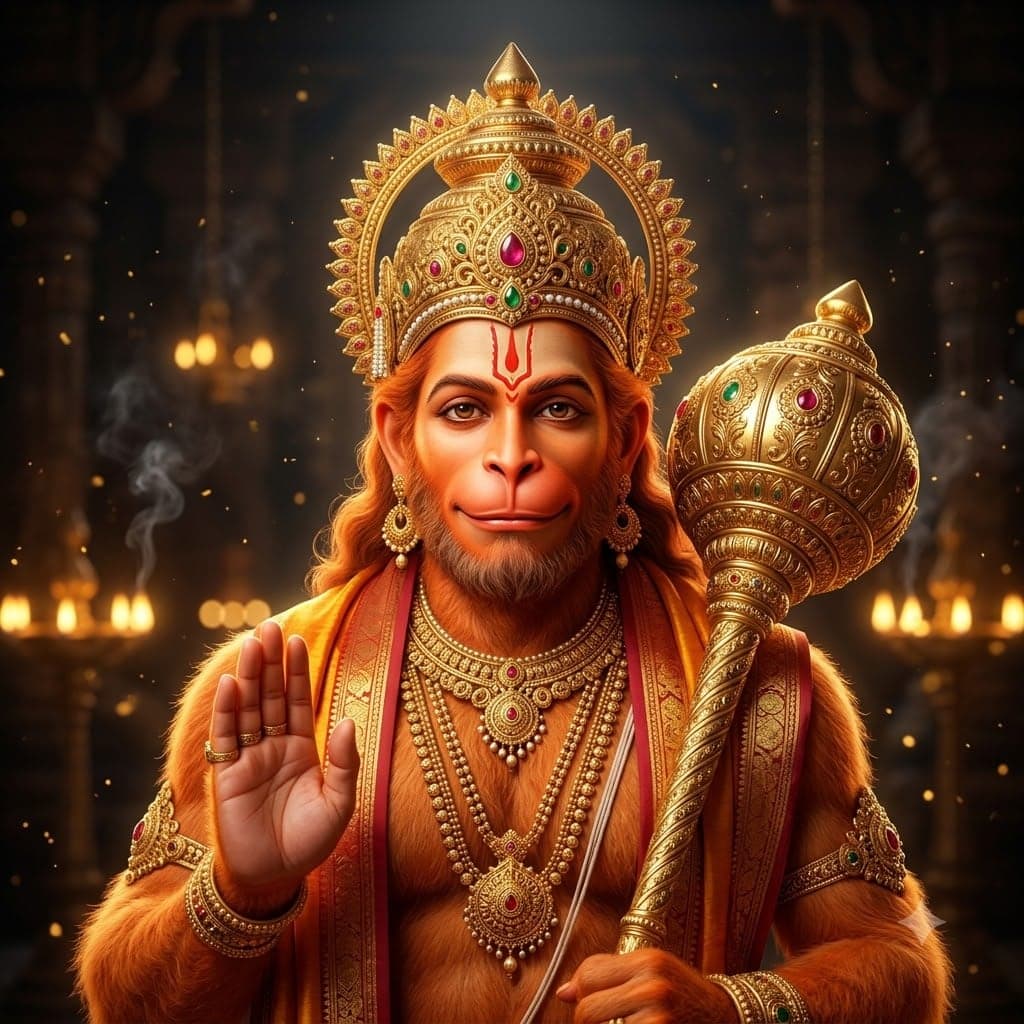
At a glance: Hanuman
- Also known as
- Maruti, Bajrangbali, Anjaneya, Pavanputra, Kesari Nandan, Sankat Mochan, Mahavir, Ramdoot, Balaji (Rajasthan)
- Family
- Son of Anjana and the vanara chief Kesari, and of the wind god Vayu (Valmiki Ramayana); the Shiva Purana calls him an incarnation of Shiva. A lifelong brahmachari in most traditions
- Shown with
- A vanara with a long tail and a mace; golden or coppery in the texts, orange with sindoor in temples; shown kneeling before Rama, carrying the herb mountain, or five-faced
- Worshipped on
- Hanuman Jayanti, on Chaitra Purnima in Maharashtra and the north (other dates in the south); Tuesday and Saturday; sindoor with oil, the Hanuman Chalisa and the Sundar Kand
- Holy places
- Anjaneri near Nashik, and Anjanadri at Hampi and at Tirumala, each held to be his birthplace; Hanumangarhi, Ayodhya; Sankat Mochan, Varanasi; Salasar and Mehandipur Balaji; Ramdas’s eleven Marutis
The leap across the ocean
Hanuman’s mission begins with a reminder. As a boy Hanuman had pestered the sages, and sages of the lines of Bhrigu and Angiras cursed him to forget his power until it was recalled to him (Valmiki Ramayana, Uttara Kanda 36). On the southern shore the bear-king Jambavan recalled it, and Hanuman leapt for Lanka from Mount Mahendra (Kishkindha Kanda 67).
Hanuman’s crossing is full of tests (Sundara Kanda 1). The ocean raised the golden mountain Mainaka for Hanuman to rest on; Hanuman only touched it and flew on, vowing not to stop. The gods sent Surasa, mother of the serpents, to test him: as her jaws widened Hanuman grew larger, then shrank to the size of a thumb, darted in and out of her mouth, honouring her boon. The demoness Simhika caught his shadow from the sea; Hanuman dived into her jaws and tore her apart.
At night Lanka’s guardian spirit, who called herself the city itself, barred the way and struck Hanuman. Hanuman felled her with his left fist, holding back because she was a woman. She recalled Brahma’s word that when a monkey overpowered her, the rakshasas’ ruin would be near (Sundara Kanda 3.47), and let him in.
Sita, the ring and the jewel
Hanuman searched Ravana’s palaces all night and found Sita in the Ashoka grove, thin from fasting and guarded by rakshasis, and watched her from a shimshapa tree (Sundara Kanda 14–15). To win her trust he gave her Rama’s ring: “रामनामाङ्कितं चेदं पश्य देव्यङ्गुलीयकम्”, “see this ring, marked with Rama’s name” (5.36.2).
Hanuman offered to carry Sita home on his back. Sita refused: she would not willingly touch anyone but Rama, and rescuing her was a deed worthy of Rama himself (Sundara Kanda 37). As a token she recalled a story only Rama knew, of a crow at Chitrakuta, and gave Hanuman the chudamani, the jewel from her hair (5.38.69).
The grove, Aksha and Indrajit’s weapon
Hanuman’s next move was deliberate, and the Valmiki Ramayana gives his reasons (Sundara Kanda 41). Talks, gifts or sowing division would not work on proud, wealthy rakshasas, so only force was left (5.41.3), and measuring the enemy’s strength before going home would truly fulfil his master’s order (5.41.7). So Hanuman wrecked the Ashoka grove, knowing it would bring Ravana’s warriors to him.
Hanuman crushed the guards Ravana sent, set a lofty temple ablaze by whirling one of its pillars (Sundara Kanda 43), and killed the generals who followed. Hanuman admired the courage of Ravana’s young son Aksha and was loath to kill him, but judged that a spreading fire cannot be ignored, and dashed him to the ground (Sundara Kanda 47).
Ravana’s son Indrajit then bound Hanuman with the Brahma weapon (Sundara Kanda 48). Hanuman felt no pain, remembering Brahma’s boon, and submitted, since capture would bring him before Ravana. When the rakshasas added ropes of hemp and bark, the weapon’s hold broke, since it tolerates no other bond, yet Hanuman let himself be dragged to the king.
Ravana’s court and the burning tail
Before Ravana, Hanuman named himself Rama’s messenger and urged him to return Sita (Sundara Kanda 50–51). Ravana ordered him killed. Vibhishana, Ravana’s younger brother, objected that the good never allow an envoy to be killed, “न दूतवध्यां प्रवदन्ति सन्तः” (5.52.14), though disfigurement, whipping, a shaven head or branding are allowed (5.52.15). Ravana agreed: the tail is a monkey’s dearest ornament, so burn it and send him back disgraced (5.53.3).
The rakshasas wrapped Hanuman’s tail in oil-soaked cotton rags, set it alight and paraded him through the streets. Hanuman let them, wishing to see Lanka’s defences by day (Sundara Kanda 53). Sita prayed to Agni: “यदि चास्त्येकपत्नीत्वं शीतो भव हनूमतः”, if I have been a faithful wife, be cool to Hanuman (5.53.28). The flame blazed but did not burn him, and the wind god, Hanuman’s father, blew cold on it.
That is why Lanka burned. Free, Hanuman asked what more could torment the rakshasas: with the grove ruined and their warriors slain, only their stronghold remained, and it was fitting to feed the fire on his tail with their finest houses (5.54.4–5). Leaping from roof to roof, Hanuman burned the mansions of Prahasta, Kumbhakarna, Indrajit and others and Ravana’s own palace, sparing only Vibhishana’s house (5.54.16), then quenched his tail in the sea.
Seeing the city burn, Hanuman felt remorse: a true man casts off rising anger as a snake sheds its skin (5.55.6), and in his rage he had forgotten Sita. Then he recalled that the fire had spared his own tail, and heard the Charanas say that Janaki lived. Hanuman returned to the shimshapa tree, found Sita unharmed and took his leave (Sundara Kanda 55–56).
How Tulsidas tells it, and Lanka Dahan today
Tulsidas’s Ramcharitmanas, whose Sundar Kand is widely recited today, shifts the emphasis. Lanka’s guardian is named Lankini; struck by Hanuman’s fist, she recalls Brahma’s sign and praises a moment of satsang above heaven and liberation (Sundara Kanda, doha 4). Hanuman then finds a house marked with Rama’s weapons and planted with tulsi; Vibhishana wakes chanting “राम राम” and shows him the way to Sita (dohas 5–8), a meeting Valmiki does not have.
In the Manas, Hanuman wrecks the grove after asking Sita’s leave to eat its fruit (doha 17). Ravana burns the tail so that the tailless monkey will fetch his master, and Hanuman smiles, sensing Saraswati’s help (dohas 24–25). He burns the city in an instant, all but Vibhishana’s house, as in Valmiki: “जारा नगरु निमिष एक माहीं। एक बिभीषन कर गृह नाहीं॥” (doha 26). Fire cannot burn the messenger of fire’s creator, and Hanuman goes straight to Sita, who only now gives him her chudamani (dohas 26–27).
Lanka Dahan is a highlight of the Ramlila staged across North India at Navratri and Dussehra: at Delhi’s Lav-Kush Ramlila it draws over a lakh of people, against about 20,000 on other nights (Patriot, 2025). In Maharashtra, Dadasaheb Phalke, born at Trimbak near Nashik, filmed the episode as Lanka Dahan in 1917, and in the Geet Ramayan, broadcast from Pune in 1955–56, Lava and Kusha sing “पेटवी लंका हनुमंत”.
Festivals of this story
Aartis and bhajans of Hanuman
- Hanuman Chalisa
- Hanuman Aarti
- Maine Tere Hi Bharose Hanuman (Sagar Mein Naiya Daar Dai)
- Hanuman Gayatri Mantra
- Manojavam Marutatulyavegam
- Hriday Mein Jinke Sitaram (Hanuman Ansh)
- Bajrang Baan
- Veer Hanumana Ati Balwana
Frequently asked questions
Why Did Hanuman Burn Lanka? The Story of Lanka Dahan
Hanuman burned Lanka because Ravana, told by Vibhishana that a messenger may not be killed, had his tail set on fire instead. In the Valmiki Ramayana Hanuman broke free and turned that fire on Ravana’s city to break the enemy’s strength, while Sita’s prayer kept the flame cool on him.
What are the other names of Hanuman?
Maruti, Bajrangbali, Anjaneya, Pavanputra, Kesari Nandan, Sankat Mochan, Mahavir, Ramdoot, Balaji (Rajasthan)
What other stories are told about Hanuman?
Is Hanuman Still Alive? Why He Is a Chiranjivi; Where Was Hanuman Born? Anjaneri, Hampi or Tirumala; Why Is Hanuman Offered Sindoor? Why His Idols Are Orange; How Did Hanuman First Meet Rama? The Story at Rishyamuka; Why Did Hanuman Carry the Sanjeevani Mountain? The Two Flights. Each is on Dharmasthan with its sources, in English, Hindi and Marathi.
Sources
- Valmiki Ramayana, Sundara Kanda, ch. 1–56 (Hari Prasad Shastri tr.): The crossing (1), Lanka’s guardian (3), Sita in the Ashoka grove (14–15), the ring (36), Sita’s refusal and the chudamani (37–38), Hanuman’s reasons and the grove (41), the temple (43), Aksha (47), Indrajit’s Brahma weapon (48), Vibhishana’s plea (52), the burning tail (53), the burning of Lanka (54), Hanuman’s remorse and return to Sita (55–56). This translation leaves out the half-verse sparing Vibhishana’s house (5.54.16) Read the text
- Valmiki Ramayana, Sundara Kanda, Sanskrit text with translation and commentaries (IIT Kanpur; Gita Press verse numbering): Verses cited: 3.47, 36.2, 38.69, 41.3, 41.7, 52.14–15, 53.3, 53.28, 54.4–5, 54.16 (Maheshvara Tirtha’s commentary: Hanuman spared the house because Vibhishana had saved his life) and 55.6 Read the text
- Valmiki Ramayana, Uttara Kanda 36 and Kishkindha Kanda 67 (Hari Prasad Shastri tr.): The sages of Bhrigu’s and Angiras’s lines curse Hanuman to forget his power (Uttara 36); the leap from Mount Mahendra (Kishkindha 67) Read the text
- Tulsidas, Ramcharitmanas, Sundara Kanda, dohas 1–27 (Gita Press text): Lankini (4); Vibhishana’s house marked with Rama’s weapons, and his meeting with Hanuman (5–8); Sita’s leave to eat the fruit (17); the Brahma weapon (19–20); Vibhishana’s plea and the tail (24–25); the burning, sparing Vibhishana’s house (26); the chudamani (27)
- Yusra Nazim, “Dussehra in Old Delhi: Ramlila traditions that bind generations”, Patriot, 1 October 2025: At Delhi’s Lav-Kush Ramlila, Lanka Dahan draws over a lakh of people, against about 20,000 on ordinary days Read the text
- G. D. Madgulkar and Sudhir Phadke, Geet Ramayan (All India Radio, Pune, 1955–56), song 41: “पेटवी लंका हनुमंत”: the burning of Lanka, sung as Lava and Kusha (first broadcast January 1956)
- Dadasaheb Phalke, Lanka Dahan (silent film, 1917): The burning of Lanka filmed by Phalke, born at Trimbak in Nashik district, with Marathi intertitles; first shown in Pune in 1917