
Stories of Hanuman
Is Hanuman Still Alive? Why He Is a Chiranjivi
By the Dharmasthan team · Updated · 7 sources cited
Hindu tradition holds that Hanuman is still alive, as one of the chiranjivis, the long-lived ones. In the Valmiki Ramayana Rama grants that Hanuman will live as long as Rama’s story is told on earth; the Mahabharata and the Bhagavata Purana show him still living in later ages.
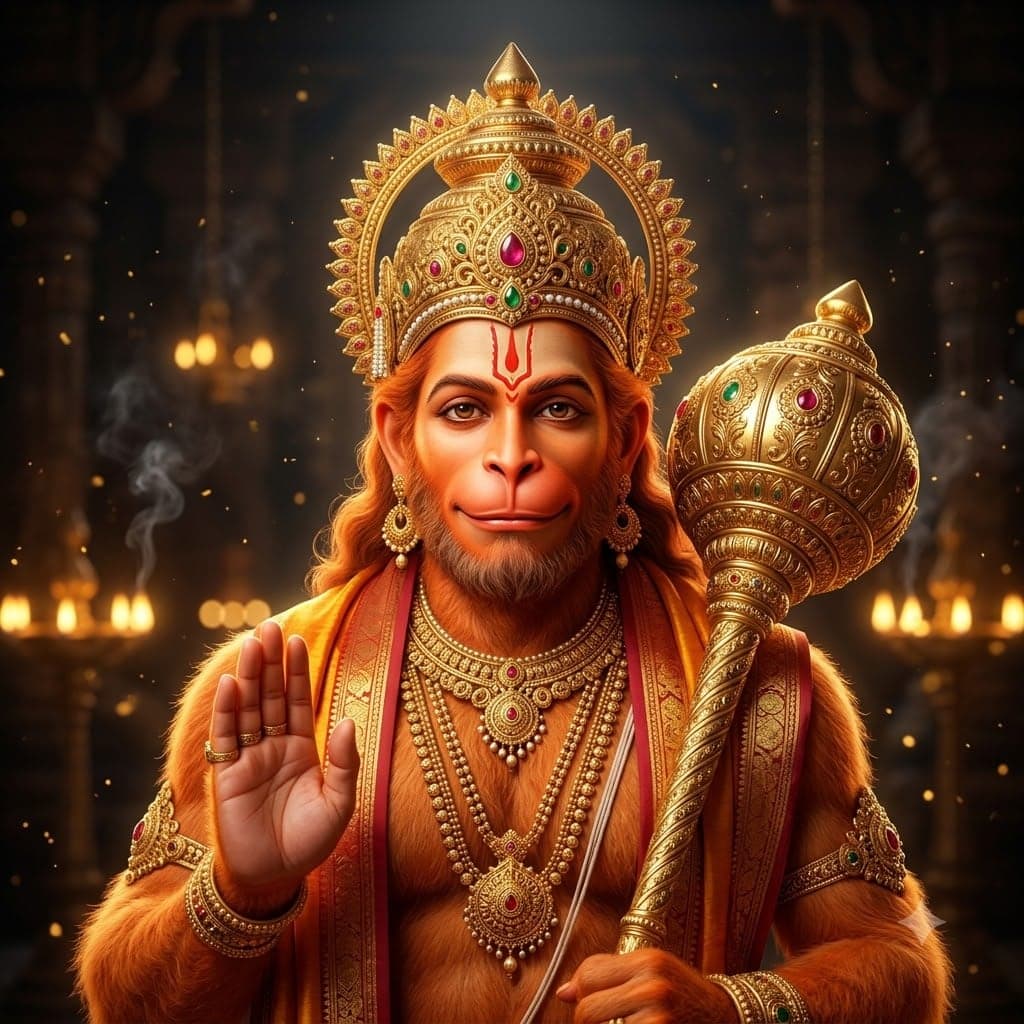
At a glance: Hanuman
- Also known as
- Maruti, Bajrangbali, Anjaneya, Pavanputra, Kesari Nandan, Sankat Mochan, Mahavir, Ramdoot, Balaji (Rajasthan)
- Family
- Son of Anjana and the vanara chief Kesari, and of the wind god Vayu (Valmiki Ramayana); the Shiva Purana calls him an incarnation of Shiva. A lifelong brahmachari in most traditions
- Shown with
- A vanara with a long tail and a mace; golden or coppery in the texts, orange with sindoor in temples; shown kneeling before Rama, carrying the herb mountain, or five-faced
- Worshipped on
- Hanuman Jayanti, on Chaitra Purnima in Maharashtra and the north (other dates in the south); Tuesday and Saturday; sindoor with oil, the Hanuman Chalisa and the Sundar Kand
- Holy places
- Anjaneri near Nashik, and Anjanadri at Hampi and at Tirumala, each held to be his birthplace; Hanumangarhi, Ayodhya; Sankat Mochan, Varanasi; Salasar and Mehandipur Balaji; Ramdas’s eleven Marutis
Rama’s boon in the Valmiki Ramayana
The clearest answer comes from the Valmiki Ramayana. After Rama’s coronation, as Rama sends his allies home, Hanuman bows and says that his love and devotion will never turn to anyone else, and that as long as Rama’s story is told in the world, life will remain in his body (Uttara Kanda 40, Hari Prasad Shastri tr.). In the critical edition Hanuman puts it more personally: as long as he hears Rama’s story on earth, may his life stay in his body (7.39.15–16). The longer vulgate text adds that the apsaras will recount Rama’s deeds to him, and hearing them will drive away his cares.
Rama rises from his throne, embraces Hanuman and grants it: as long as the worlds endure, Rama’s story will endure, and as long as that story travels the worlds, life will remain in Hanuman’s body (7.39.17–19). In the vulgate Rama adds that he could give his life for each of Hanuman’s services and still be in his debt. Rama then takes the necklace from his own neck, pearls with a gem as bright as the moon, and ties it on Hanuman (7.39.20).
Rama repeats the boon at the end of his reign, as he prepares to leave the world. Rama tells Vibhishana to rule Lanka as long as there are people, and tells Hanuman: you have resolved to live, so do not break your promise; as long as stories of me are told in the world, keep your life (Uttara Kanda 108, Shastri tr.; 7.98.22–25 in the critical edition). In the vulgate Hanuman answers that he will stay on earth, obedient to Rama’s will, as long as Rama’s story is told. The other monkeys and bears follow Rama into the Sarayu and return to the gods they were born from (7.100.18–24). Hanuman stays behind.
These were not Hanuman’s first boons. As a child Hanuman was promised long life by the gods (Uttara Kanda 36), and Indra granted that he would die only when he chose, a boon told in the story of Hanuman Jayanti (Kishkindha Kanda 66). Rama’s boon is different: it ties Hanuman’s life not to a number of years but to the life of the Ramayana itself.
Alive in the Dvapara age: Hanuman meets Bhima
The Mahabharata shows Hanuman alive long after Rama’s departure. During the Pandavas’ exile, Bhima climbs the Gandhamadana mountain to fetch Saugandhika lotuses for Draupadi and finds an old monkey lying across the path, whose tail he cannot lift even with both arms (Vana Parva 146, K. M. Ganguli tr.). The monkey is Hanuman, Bhima’s elder brother, since both are sons of the wind god. Hanuman tells him Rama’s story and recalls asking Rama, “may I live as long as the history of thy deeds remaineth extant on earth!”, to which Rama said, “So be it.” Ever since, Hanuman says, apsaras and gandharvas delight him by singing Rama’s deeds (Vana Parva 147). Asked to show the form that leapt the ocean, Hanuman replies that the age has changed and he conforms to it (148). The Mahabharata sets its own war between the Dvapara and Kali ages (Adi Parva 2), so this meeting shows Hanuman living on into the Dvapara age.
Kimpurusha-varsha: where the Bhagavata places Hanuman
The Bhagavata Purana, told by the sage Shuka to King Parikshit, Arjuna’s grandson, speaks of Hanuman in the present tense. Describing the lands of Jambudvipa, the Purana places Kimpurusha-varsha between the Hemakuta range and the Himalaya, next to Bharata-varsha (5.16.9). There, Shuka says, Hanuman, the great devotee, worships Rama, Lakshmana’s elder brother and Sita’s beloved, with the people of that land, in unbroken devotion (5.19.1).
In Kimpurusha-varsha the gandharvas sing Rama’s most auspicious story, and Hanuman listens with Arshtishena, the chief of that land, and chants a hymn himself (5.19.2). Hanuman’s prayer follows (5.19.3–8). In it Hanuman says that Rama made friends of forest-dwellers like him, who had neither high birth, beauty, eloquence nor learning (5.19.7), and that god or demon, monkey or human, everyone should worship Rama (5.19.8).
The three texts agree on one detail: Hanuman lives where Rama’s story is sung. In the vulgate Valmiki Ramayana the apsaras are to recount Rama’s deeds to him; in the Mahabharata apsaras and gandharvas sing them; in the Bhagavata the gandharvas do. The Ramayana makes the story itself lasting: at the start of the epic Brahma tells Valmiki that as long as mountains stand and rivers flow on earth, the Ramayana will be told in the worlds (Bala Kanda 2; 1.2.35 in the critical edition). Read together, the texts say Hanuman lives as long as the Ramayana is told.
The seven chiranjivis and devotion today
Chiranjivi means “long-lived”, and Hanuman is the best known of the seven chiranjivis named in a verse recited across India: “अश्वत्थामा बलिर्व्यासो हनूमांश्च विभीषणः। कृपः परशुरामश्च सप्तैते चिरजीविनः॥” They are Ashvatthama, Bali, Vyasa, Hanuman, Vibhishana, Kripa and Parashurama. The verse appears in the Padma Purana, among names to remember on waking (Srishti Khanda 49). The form usually recited today adds a second line naming Markandeya as an eighth; where that line comes from has not been established.
Devotion takes the promise literally. The Hanuman Chalisa, attributed to Tulsidas, sings “चारों जुग परताप तुम्हारा”: Hanuman’s glory spans all four ages. A traditional Sanskrit verse whose source is not known, “यत्र यत्र रघुनाथकीर्तनं तत्र तत्र कृतमस्तकाञ्जलिम्”, says that wherever Rama’s praise is sung, Maruti is there, palms joined above his head and eyes full of tears. From this belief comes the custom of leaving an empty seat for Hanuman at Ramayana kathas and Sundar Kand readings. That is custom, not scripture.
In Maharashtra, Ram temples hold kirtans and Ramayana readings through the nine days of Chaitra Navratri, and Maruti’s own festival, Hanuman Jayanti, follows on Chaitra Purnima, six days after Ram Navami. The scriptures place Hanuman on Gandhamadana or in Kimpurusha-varsha, living for as long as Rama’s story is told. They do not describe Hanuman appearing to people in the present age; for devotees, hearing and reading the Ramayana is itself the way to be near him.
Aartis and bhajans of Hanuman
- Hanuman Chalisa
- Hanuman Aarti
- Maine Tere Hi Bharose Hanuman (Sagar Mein Naiya Daar Dai)
- Hanuman Gayatri Mantra
- Manojavam Marutatulyavegam
- Hriday Mein Jinke Sitaram (Hanuman Ansh)
- Bajrang Baan
- Veer Hanumana Ati Balwana
Frequently asked questions
Is Hanuman Still Alive? Why He Is a Chiranjivi
Hindu tradition holds that Hanuman is still alive, as one of the chiranjivis, the long-lived ones. In the Valmiki Ramayana Rama grants that Hanuman will live as long as Rama’s story is told on earth; the Mahabharata and the Bhagavata Purana show him still living in later ages.
What are the other names of Hanuman?
Maruti, Bajrangbali, Anjaneya, Pavanputra, Kesari Nandan, Sankat Mochan, Mahavir, Ramdoot, Balaji (Rajasthan)
What other stories are told about Hanuman?
Where Was Hanuman Born? Anjaneri, Hampi or Tirumala; Why Is Hanuman Offered Sindoor? Why His Idols Are Orange; How Did Hanuman First Meet Rama? The Story at Rishyamuka; Why Did Hanuman Burn Lanka? The Story of Lanka Dahan; Why Did Hanuman Carry the Sanjeevani Mountain? The Two Flights. Each is on Dharmasthan with its sources, in English, Hindi and Marathi.
Sources
- Valmiki Ramayana, Uttara Kanda 40 (Hari Prasad Shastri tr., vulgate text): Hanuman’s wish to live as long as Rama’s story is told, Rama’s grant, the debt of gratitude and the necklace Read the text
- Valmiki Ramayana, Uttara Kanda 108 (Hari Prasad Shastri tr., vulgate text): Rama’s last commands: Vibhishana to rule Lanka, Hanuman to live on while Rama’s story is told, Jambavan until the Kali age Read the text
- Valmiki Ramayana, Baroda critical edition (GRETIL e-text): Brahma’s promise that the Ramayana will last (1.2.35); childhood boons (7.36); the farewell and boon (7.39.15–20); the last commands (7.98.22–25); the monkeys return to the gods (7.100.18–24) Read the text
- Mahabharata, Vana Parva 146–148 (K. M. Ganguli tr.): Bhima and the old monkey on Gandhamadana; Hanuman recalls Rama’s boon (147) and conforms to the age (148) Read the text
- Mahabharata, Adi Parva 2 (K. M. Ganguli tr.): The Kurukshetra war took place between the Dvapara and Kali ages Read the text
- Bhagavata Purana 5.16.9 and 5.19.1–8: Kimpurusha-varsha between Hemakuta and the Himalaya; Hanuman worships Rama there and hears his story sung by gandharvas; Hanuman’s prayer Read the text
- Padma Purana, Srishti Khanda 49 (N. A. Deshpande tr.): The seven long-lived ones, Hanuman among them, in the names to remember on rising Read the text