
Stories of Hanuman
Why Did Hanuman Carry the Sanjeevani Mountain? The Two Flights
By the Dharmasthan team · Updated · 7 sources cited
Hanuman carried the Sanjeevani mountain because there was no time to find the healing herbs: in the Valmiki Ramayana they hid from him on his first flight, and on the second he could not tell them apart, so he brought the whole peak to revive Lakshmana and the army.
At a glance: Hanuman
- Also known as
- Maruti, Bajrangbali, Anjaneya, Pavanputra, Kesari Nandan, Sankat Mochan, Mahavir, Ramdoot, Balaji (Rajasthan)
- Family
- Son of Anjana and the vanara chief Kesari, and of the wind god Vayu (Valmiki Ramayana); the Shiva Purana calls him an incarnation of Shiva. A lifelong brahmachari in most traditions
- Shown with
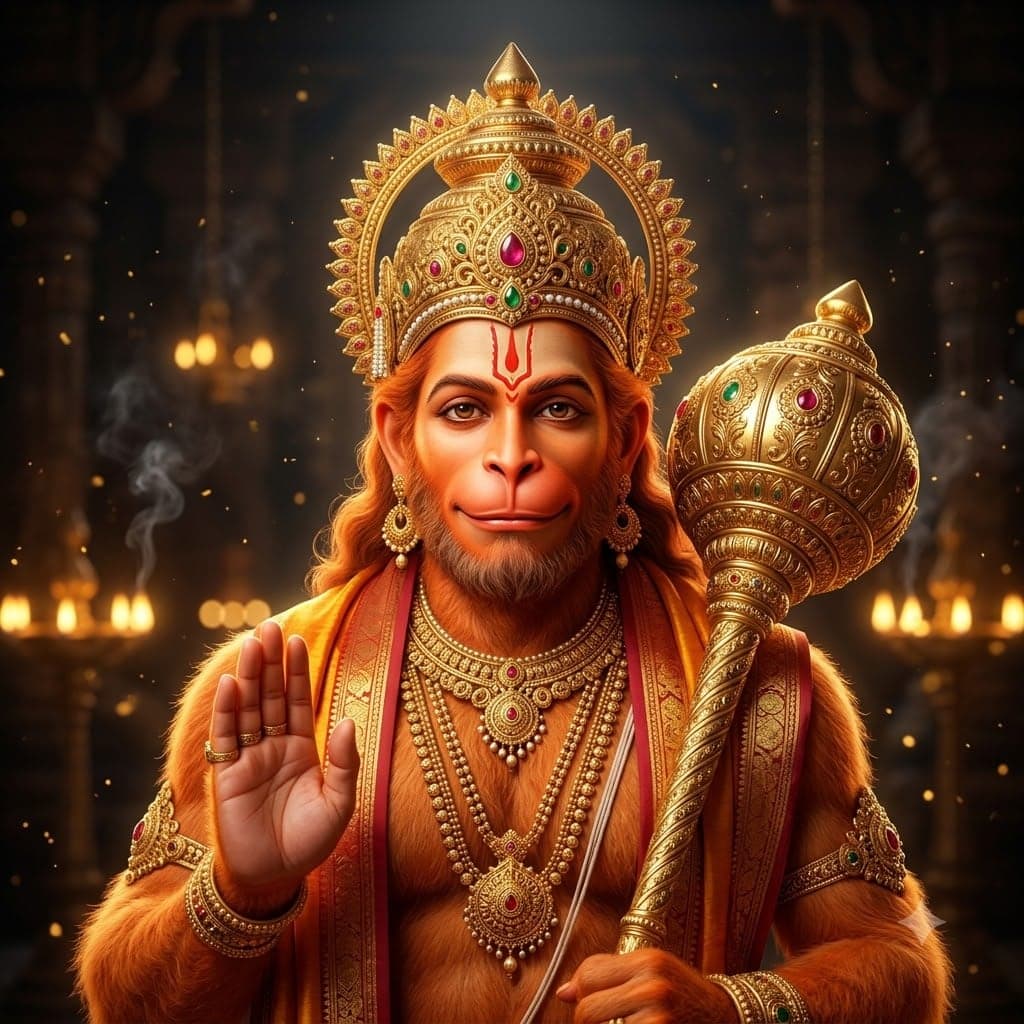
- A vanara with a long tail and a mace; golden or coppery in the texts, orange with sindoor in temples; shown kneeling before Rama, carrying the herb mountain, or five-faced
- Worshipped on
- Hanuman Jayanti, on Chaitra Purnima in Maharashtra and the north (other dates in the south); Tuesday and Saturday; sindoor with oil, the Hanuman Chalisa and the Sundar Kand
- Holy places
- Anjaneri near Nashik, and Anjanadri at Hampi and at Tirumala, each held to be his birthplace; Hanumangarhi, Ayodhya; Sankat Mochan, Varanasi; Salasar and Mehandipur Balaji; Ramdas’s eleven Marutis
Valmiki’s first flight: the herbs that hid
The Valmiki Ramayana tells of Hanuman fetching the herb mountain twice. The first time comes after Ravana’s son Indrajit strikes down Rama, Lakshmana and much of the monkey army with a weapon of Brahma (Yuddha Kanda 74, Hari Prasad Shastri’s translation). That night Vibhishana and Hanuman find the aged bear king Jambavan pierced with arrows. Jambavan’s first question is whether Hanuman is alive: “तस्मिन् जीवति वीरे तु हतमप्यहतं बलम्”, if that hero lives, the army is not lost, though it lies struck down (74.22).
Jambavan tells Hanuman that no one else has the strength for the task (Yuddha Kanda 74.27) and sends him across the sea to the Himalaya. Between the golden Rishabha peak and Mount Kailasa, he says, stands a glowing mountain of herbs, and on its summit grow four: Mritasanjivani, which brings the dead back to life; Vishalyakarani, which heals the wounds of weapons; Suvarnakarani, which restores the body’s colour; and Sandhani, which joins what was broken (74.29–33). The popular name Sanjeevani comes from the first herb; Valmiki calls the place simply the oshadhi-parvata, the mountain of herbs (74.31).
On the Himalaya the herbs, knowing that someone had come to take them, make themselves invisible (Yuddha Kanda 74.64). Angry that the mountain shows no pity for Rama, Hanuman breaks off its whole crest, with its trees, elephants and ores, and flies back shining like a second sun (74.65–69). The scent of the herbs alone heals Rama and Lakshmana, and the fallen monkeys rise like sleepers waking at the end of the night (74.73–74). Afterwards Hanuman carries the peak back to the Himalaya (74.77).
Valmiki’s second flight: Lakshmana and Ravana’s spear
Hanuman’s second flight comes later in the war, when Ravana hurls at Lakshmana a spear made by the magic of Maya, angry that Lakshmana had saved Vibhishana from him (Yuddha Kanda 101.28–34). Rama asks what use there is in fighting or living without his brother. The monkey chief Sushena assures him that Lakshmana still lives, for his face has not changed and his heart still beats (Yuddha Kanda 102 in Shastri’s translation; sarga numbers here differ slightly between editions).
Sushena sends Hanuman back to the mountain of herbs that Jambavan had described, for the herbs on its southern peak; Shastri’s translation names it Mount Mahodaya (Yuddha Kanda 102.23–25). This time Hanuman cannot recognise the herbs and fears that any delay will be fatal. So he breaks off the summit, carries it back in both hands and tells Sushena: “ओषधीर्नावगच्छामि ता अहं हरिपुङ्गव। तदिदं शिखरं कृत्स्नं गिरेस्तस्याहृतं मया॥”, I do not know those herbs, so I have brought the whole summit (102.26–34). Sushena crushes the herb and holds it to Lakshmana’s nose, and Lakshmana rises, free of the spear and its pain (102.37–38).
In the Valmiki Ramayana, then, the answer is practical. Jambavan chooses Hanuman because no one else has the strength to cross the sea to the Himalaya and back, and Hanuman brings the whole peak because the herbs either hid or could not be told apart.
Later tellings: Kalanemi and Bharata’s arrow
The Shiva Purana, which counts Hanuman as an incarnation of Shiva, gives the episode one verse: Hanuman revived Lakshmana with the herb Sanjivani when he was wounded by Meghanada’s javelin (Shatarudra Samhita 20.31). Here it is Meghanada, Indrajit’s other name, not Ravana, who strikes Lakshmana, as in Tulsidas.
The Adhyatma Ramayana, a later Sanskrit Ramayana, keeps Ravana’s spear but adds the demon Kalanemi, whom Ravana sends to delay Hanuman (Yuddha Kanda 6–7, Baij Nath’s translation). Kalanemi poses as a sage in an illusory hermitage. A she-crocodile in its lake seizes Hanuman; when he kills her, she rises as a celestial woman freed from a curse and warns him. Hanuman kills Kalanemi, cannot find the herb and uproots the whole Drona hill (7.22–34).
Tulsidas’s Ramcharitmanas tells the story with the most drama (Lanka Kanda, dohas 54–62). On Jambavan’s advice Hanuman fetches Sushena, here a physician living in Lanka, house and all. After killing Kalanemi, Hanuman cannot recognise the herb, uproots the mountain and flies back by night over Ayodhya. Bharata takes him for a demon and brings him down with a headless arrow. Hanuman falls calling “राम राम”; Bharata revives him by the truth of his love for Rama and offers to send him to Rama on his arrow, mountain and all. Hanuman declines and reaches Rama after midnight, as Rama laments that a brother can never be found again. None of this is in Valmiki, whose two chapters have no Kalanemi, no Bharata and no physician from Lanka.
Why is the mountain called Dronagiri?
Valmiki never calls the herb mountain Dronagiri. A Drona mountain does appear in his epic, but in an earlier episode: when Indrajit’s serpent-arrows bind Rama and Lakshmana, Sushena proposes sending Hanuman to the Chandra and Drona mountains in the Ocean of Milk, where healing herbs grow (“चन्द्रश्च नाम द्रोणश्च क्षीरोदे सागरोत्तमे”, Yuddha Kanda 50.29–32). Garuda frees the brothers before Hanuman sets out. In the Adhyatma Ramayana the mountain Hanuman actually carries is the Drona hill in the Ocean of Milk (Yuddha Kanda 5.71–74, 7.33–34), and Dronagiri is the name most people know today.
In Maharashtra the name is known from the hymn most recited to Maruti, Samarth Ramdas’s “Bhimrupi Maharudra”, the Maruti Stotra: “मंदाद्रिसारिखा द्रोणू क्रोधें उत्पाटिला बळें”, in fury Hanuman tore up Drona, a hill like Mount Mandara. The next verse, “आणिला मागुती नेला”, says he brought it and took it back again, as in Valmiki’s first flight (verses 9–10).
Two local traditions grew from the story. Dronagiri village, at about 3,600 metres in Chamoli district, Uttarakhand, worships its mountain as Parbat Dev; by local custom it has not forgiven Hanuman for tearing away the mountain’s right flank, keeps no image of him and leaves him out of its Ramlila (Scroll.in, 2016). In Sri Lanka, local tradition holds that pieces of the peak fell on the island during the flight; Rumassala, near Galle, is one of them. Both are traditions of those places, not scripture.
Aartis and bhajans of Hanuman
- Hanuman Chalisa
- Hanuman Aarti
- Maine Tere Hi Bharose Hanuman (Sagar Mein Naiya Daar Dai)
- Hanuman Gayatri Mantra
- Manojavam Marutatulyavegam
- Hriday Mein Jinke Sitaram (Hanuman Ansh)
- Bajrang Baan
- Veer Hanumana Ati Balwana
Frequently asked questions
Why Did Hanuman Carry the Sanjeevani Mountain? The Two Flights
Hanuman carried the Sanjeevani mountain because there was no time to find the healing herbs: in the Valmiki Ramayana they hid from him on his first flight, and on the second he could not tell them apart, so he brought the whole peak to revive Lakshmana and the army.
What are the other names of Hanuman?
Maruti, Bajrangbali, Anjaneya, Pavanputra, Kesari Nandan, Sankat Mochan, Mahavir, Ramdoot, Balaji (Rajasthan)
What other stories are told about Hanuman?
Is Hanuman Still Alive? Why He Is a Chiranjivi; Where Was Hanuman Born? Anjaneri, Hampi or Tirumala; Why Is Hanuman Offered Sindoor? Why His Idols Are Orange; How Did Hanuman First Meet Rama? The Story at Rishyamuka; Why Did Hanuman Burn Lanka? The Story of Lanka Dahan. Each is on Dharmasthan with its sources, in English, Hindi and Marathi.
Sources
- Valmiki Ramayana, Yuddha Kanda 74 and 50 (Hari Prasad Shastri tr.): The first flight: Jambavan asks for Hanuman and chooses him (74.18–27); the herb mountain between Rishabha and Kailasa and its four herbs (74.29–33); the herbs vanish and Hanuman breaks off the crest (74.64–69); the army revived and the peak taken back (74.73–77). Chapter 50: Sushena names the Chandra and Drona mountains in the Ocean of Milk (50.29–32). Verse numbers from the Sanskrit text at heritage.iitk.ac.in/VRAM, whose sargas match Shastri’s chapters Read the text
- Valmiki Ramayana, Yuddha Kanda 101–102, “Lakshmana’s miraculous Recovery” (Hari Prasad Shastri tr.): The second flight: Ravana’s spear (101.28–34); Sushena sends Hanuman to the herb mountain’s southern peak, “Mount Mahodaya” in Shastri (102.23–25); Hanuman cannot recognise the herbs and brings the whole summit (102.26–34); Lakshmana revived (102.35–38). Sarga numbers differ slightly in some editions Read the text
- Shiva Purana, Shatarudra Samhita 20 (J. L. Shastri tr.): Hanuman revives Lakshmana, wounded by Meghanada’s javelin, with the herb Sanjivani (20.31) Read the text
- Adhyatma Ramayana, Yuddha Kanda 5–7 (Rai Bahadur Lala Baij Nath tr.): Dronagiri in the Ocean of Milk (5.71–74); Ravana’s spear strikes Lakshmana (6.4–15); Kalanemi’s hermitage, the she-crocodile and Kalanemi’s death (7.1–33); the Drona hill uprooted (7.33–34) Read the text
- Tulsidas, Ramcharitmanas, Lanka Kanda, dohas 54–62: Meghanada’s spear; Sushena the physician brought from Lanka; Kalanemi; Bharata’s arrow over Ayodhya; Rama’s lament at midnight and Lakshmana’s recovery. Doha numbers as in the IIT Kanpur text Read the text
- Samarth Ramdas, Maruti Stotra “Bhimrupi Maharudra”, verses 9–10: Hanuman tears up the Drona mountain and takes it back; text as in the Marathi Wikisource collection “Chaturdash Maruti Stotre” Read the text
- Mrinal Pande, “The Sanjivani quest: An Uttarakhand village hasn’t forgiven Hanuman for defacing their holy mountain”, Scroll.in, 31 July 2016: Dronagiri village, Chamoli: the mountain worshipped as Parbat Dev, no image of Hanuman, a Ramlila without him (local tradition) Read the text