
Stories of Hanuman
How Did Hanuman First Meet Rama? The Story at Rishyamuka
By the Dharmasthan team · Updated · 6 sources cited
Hanuman first met Rama at Mount Rishyamuka near Lake Pampa, where Sugriva, afraid that Vali had sent the two armed brothers, sent Hanuman to question them disguised as a wandering monk. In the Valmiki Ramayana Rama praises his flawless speech, and Hanuman carries Rama and Lakshmana on his back to Sugriva.
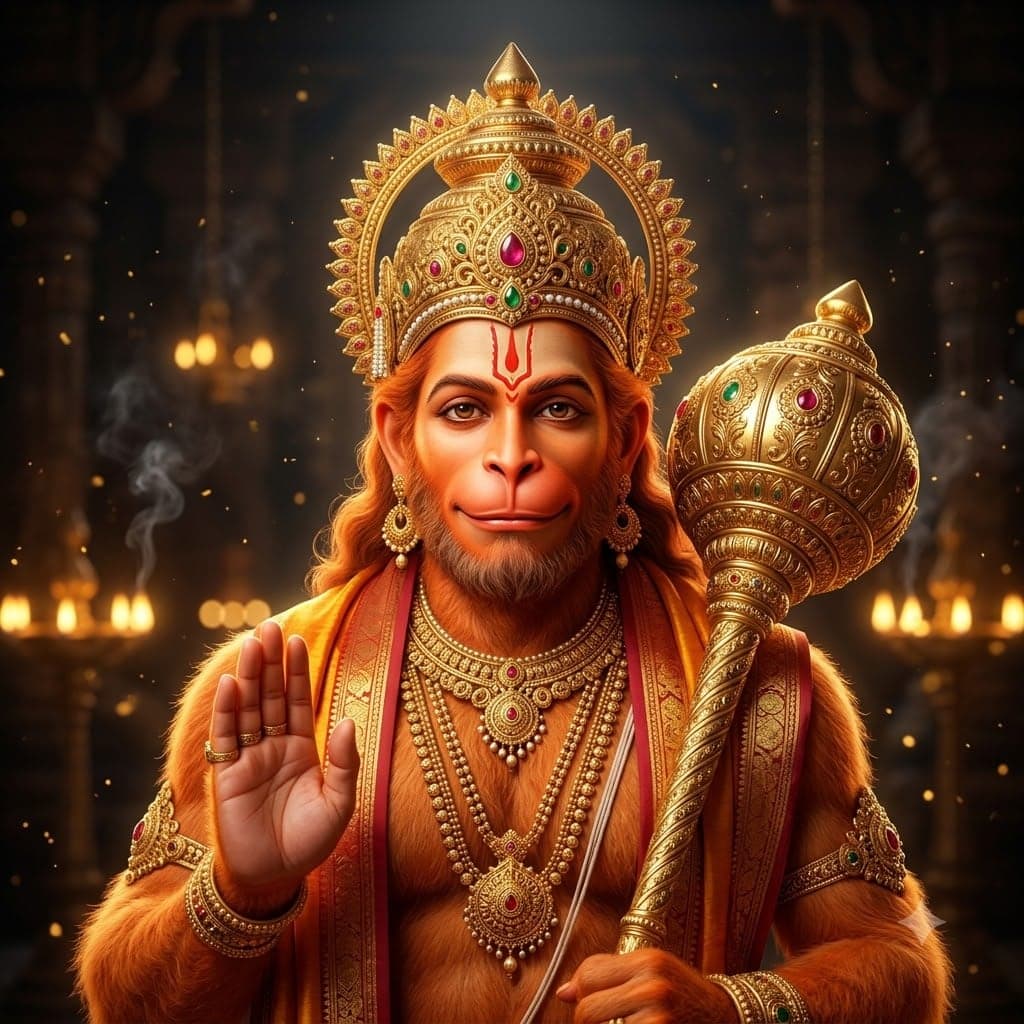
At a glance: Hanuman
- Also known as
- Maruti, Bajrangbali, Anjaneya, Pavanputra, Kesari Nandan, Sankat Mochan, Mahavir, Ramdoot, Balaji (Rajasthan)
- Family
- Son of Anjana and the vanara chief Kesari, and of the wind god Vayu (Valmiki Ramayana); the Shiva Purana calls him an incarnation of Shiva. A lifelong brahmachari in most traditions
- Shown with
- A vanara with a long tail and a mace; golden or coppery in the texts, orange with sindoor in temples; shown kneeling before Rama, carrying the herb mountain, or five-faced
- Worshipped on
- Hanuman Jayanti, on Chaitra Purnima in Maharashtra and the north (other dates in the south); Tuesday and Saturday; sindoor with oil, the Hanuman Chalisa and the Sundar Kand
- Holy places
- Anjaneri near Nashik, and Anjanadri at Hampi and at Tirumala, each held to be his birthplace; Hanumangarhi, Ayodhya; Sankat Mochan, Varanasi; Salasar and Mehandipur Balaji; Ramdas’s eleven Marutis
Sugriva’s fear and Hanuman’s disguise
Hanuman first met Rama on Mount Rishyamuka, beside Lake Pampa, where Rama and Lakshmana had come searching for the abducted Sita. The demon Kabandha had sent them to Sugriva, the monkey prince banished by his brother Vali, who lived there with four companions (Valmiki Ramayana, Aranya Kanda 72). Vali could not follow: the sage Matanga had cursed him to die if he set foot on the hill (Kishkindha Kanda 11).
Sugriva saw two long-armed strangers in bark clothes, armed with bows and swords, and was terrified: surely Vali had sent them (Kishkindha Kanda 2). Hanuman calmed his king, but Sugriva still sent Hanuman to find out: go as an ordinary man, watch their faces, manners and words, win their trust with praise, and learn why they have come.
Hanuman leapt down from Rishyamuka, put off his monkey form and took the guise of a bhikshu, a wandering mendicant (Kishkindha Kanda 3.2). Bowing, Hanuman praised the brothers at length, their golden skin and their bows like Indra’s, and then told them who he was: Sugriva’s minister, a monkey, the son of the Wind, come in disguise to offer his master’s friendship.
Rama’s praise of Hanuman’s speech
Rama was delighted: this was the minister of the very Sugriva he had been seeking. Then Rama spoke the verses this meeting is remembered for. No one who had not learned the Rig Veda, mastered the Yajur Veda and known the Sama Veda could speak like this (Kishkindha Kanda 3.28). Surely, Rama told Lakshmana, he has studied the whole of grammar many times, for in all his long speech not one word was faulty (3.29).
Rama went on to say what made the speech perfect (3.30–35). Nothing in Hanuman’s face, eyes or brow showed a flaw; his sentences were neither too long nor unclear, neither slow nor hurried, and rose from the chest and throat in a middle tone, so charming that even an enemy with a raised sword would be won over. A king with such a messenger succeeds in everything. Hanuman, the Uttara Kanda says, had learned grammar from the Sun, travelling with him from the mountain of sunrise to the mountain of sunset (Uttara Kanda 36).
Lakshmana then told Hanuman their story and said that Rama had come to Sugriva for refuge (Kishkindha Kanda 4). Hanuman replied that Sugriva too had lost his kingdom and his wife to his brother, and would help search for Sita.
Carrying Rama and Lakshmana to Sugriva
Hanuman then gave up the mendicant’s guise, took back his monkey form, lifted Rama and Lakshmana onto his back and bounded up the mountain to Sugriva (Kishkindha Kanda 4.34). It was Hanuman, too, who kindled the fire around which Rama and Sugriva walked to seal their friendship (Kishkindha Kanda 5), the friendship that led to Vali’s death.
Later, when the search parties set out, Sugriva gave Hanuman a special charge, certain that nothing on earth, in the sky or in the sea could stop him. Seeing this trust, Rama gave Hanuman his ring, engraved with Rama’s name, as a token by which Sita would know Rama’s messenger (Kishkindha Kanda 44.12). Hanuman bowed at Rama’s feet and set out. The monkey whose words had first won Rama’s trust became the one Rama trusted to speak to Sita.
Tulsidas’s telling: the brahmin who knew his Lord
Tulsidas opens the Kishkindha Kanda of the Ramcharitmanas with the same scene (Kishkindha Kanda, doha 1). A frightened Sugriva tells Hanuman to go as a young brahmachari and signal if Vali has sent the two men, so that Sugriva can flee. Hanuman goes “bipra rup dhari”, in a brahmin’s form, bows and asks: who are you, one dark and one fair, roaming the forest as warriors? Are you one of the three gods, or Nara and Narayana, or the Lord of all the worlds born as a man?
Rama answers simply that they are Dasharatha’s sons, searching for Sita, whom a demon has carried off, and asks the brahmin his own story. At that moment Hanuman recognises his Lord and falls at Rama’s feet; Shiva, who narrates the Manas to Parvati, says that joy cannot be described (doha 2). Hanuman gently protests: it was right for him to ask, but why did his master ask like an ordinary man? Lost in Rama’s maya, he had failed to know his Lord.
Hanuman then reveals his own form, and Rama lifts him up, holds him to his chest and bathes him in tears: you are twice as dear to me as Lakshmana (doha 3). The single-minded devotee, Rama adds, never forgets that he is the servant and the whole world the form of his Lord. Hanuman then carries both brothers on his back to Sugriva and seals their friendship with the fire as witness (doha 4). Valmiki’s Hanuman is a brilliant minister winning a stranger’s trust; Tulsidas’s Hanuman is a devotee who recognises God.
Other versions, and where the meeting is remembered
The Baroda critical edition of the Valmiki Ramayana, built from manuscripts of both the northern and southern traditions, has a shorter scene. Sugriva asks Hanuman to go as an ordinary person (4.2.23), Hanuman comes as a mendicant (4.3.3), and Rama calls him skilled in speech (4.3.25), but the verses on the Vedas and grammar and the carrying on his back are not in its main text: they belong to the longer vulgate printed by the Gita Press. The Mahabharata’s short Ramayana gives the meeting one line, with no disguise: Sugriva sends his counsellor Hanuman to receive the brothers, who speak with him before meeting Sugriva (Vana Parva, section 278 in Ganguli’s translation).
Devotees recall the meeting whenever they sing the Hanuman Chalisa, traditionally attributed to Tulsidas: “tum upkar Sugrivahin kinha, Ram milay raj pad dinha”, you did Sugriva a great service, bringing him to Rama and giving him his throne. A hill on the Tungabhadra near Anegundi, by Hampi in Karnataka, is identified by local tradition with Rishyamuka. In Maharashtra, where Hanuman is Maruti, Rama’s servant has a name of his own: Das Maruti, like the image Samarth Ramdas set up in front of the Rama temple at Chaphal in Satara district.
Aartis and bhajans of Hanuman
- Hanuman Chalisa
- Hanuman Aarti
- Maine Tere Hi Bharose Hanuman (Sagar Mein Naiya Daar Dai)
- Hanuman Gayatri Mantra
- Manojavam Marutatulyavegam
- Hriday Mein Jinke Sitaram (Hanuman Ansh)
- Bajrang Baan
- Veer Hanumana Ati Balwana
Frequently asked questions
How Did Hanuman First Meet Rama? The Story at Rishyamuka
Hanuman first met Rama at Mount Rishyamuka near Lake Pampa, where Sugriva, afraid that Vali had sent the two armed brothers, sent Hanuman to question them disguised as a wandering monk. In the Valmiki Ramayana Rama praises his flawless speech, and Hanuman carries Rama and Lakshmana on his back to Sugriva.
What are the other names of Hanuman?
Maruti, Bajrangbali, Anjaneya, Pavanputra, Kesari Nandan, Sankat Mochan, Mahavir, Ramdoot, Balaji (Rajasthan)
What other stories are told about Hanuman?
Is Hanuman Still Alive? Why He Is a Chiranjivi; Where Was Hanuman Born? Anjaneri, Hampi or Tirumala; Why Is Hanuman Offered Sindoor? Why His Idols Are Orange; Why Did Hanuman Burn Lanka? The Story of Lanka Dahan; Why Did Hanuman Carry the Sanjeevani Mountain? The Two Flights. Each is on Dharmasthan with its sources, in English, Hindi and Marathi.
Sources
- Valmiki Ramayana, Aranya Kanda 72; Kishkindha Kanda 2–5, 11 and 44; Uttara Kanda 36 (H. P. Shastri tr.): Kabandha sends Rama to Sugriva; Sugriva’s fear, Hanuman’s disguise, Rama’s praise of his speech, the carrying to Sugriva and the friendship by the fire (Kishkindha 2–5); Matanga’s curse (11); the ring (44); Hanuman’s grammar learned from the Sun (Uttara 36) Read the text
- Valmiki Ramayana, Kishkindha Kanda 3.2, 3.28–35, 4.34 and 44.12 (Sanskrit vulgate, Gita Press numbering; IIT Kanpur text): The mendicant’s guise, the verses on the three Vedas and grammar, the brothers lifted onto Hanuman’s back, the ring engraved with Rama’s name Read the text
- Valmiki Ramayana, critical edition (Oriental Institute, Baroda), Kishkindha Kanda 2–5: The shorter scene: 4.2.23, 4.3.3, 4.3.21, 4.3.25; sarga 3 ends without the verses on the Vedas and grammar, and sarga 4 without the carrying on his back (e-text on GRETIL) Read the text
- Tulsidas, Ramcharitmanas, Kishkindha Kanda, doha 1–4: Hanuman in a brahmin’s form (“बिप्र रूप धरि”), recognises Rama and falls at his feet; “twice as dear as Lakshmana”; the brothers carried on his back; the fire as witness Read the text
- Mahabharata, Vana Parva, section 278 (K. M. Ganguli tr.): The Ramopakhyana’s one-line meeting: Sugriva sends Hanuman to receive Rama and Lakshmana Read the text
- Koppal district administration, Government of Karnataka: Rushyamukha Hill: The hill on the Tungabhadra about 4 km west of Anegundi, identified by local tradition with Rishyamuka Read the text