
Stories of Ganesh
Why Is Tulsi Not Offered to Ganesha? The Story of Two Curses
By the Dharmasthan team · Updated · 6 sources cited
Tulsi is not offered to Ganesha because of a story in the Brahma Vaivarta Purana: the young Tulasi asked Ganesha to marry her, he refused, and they cursed each other. Relenting, Ganesha blessed her to become the plant dearest to Vishnu and Krishna, but said he would never accept her himself.
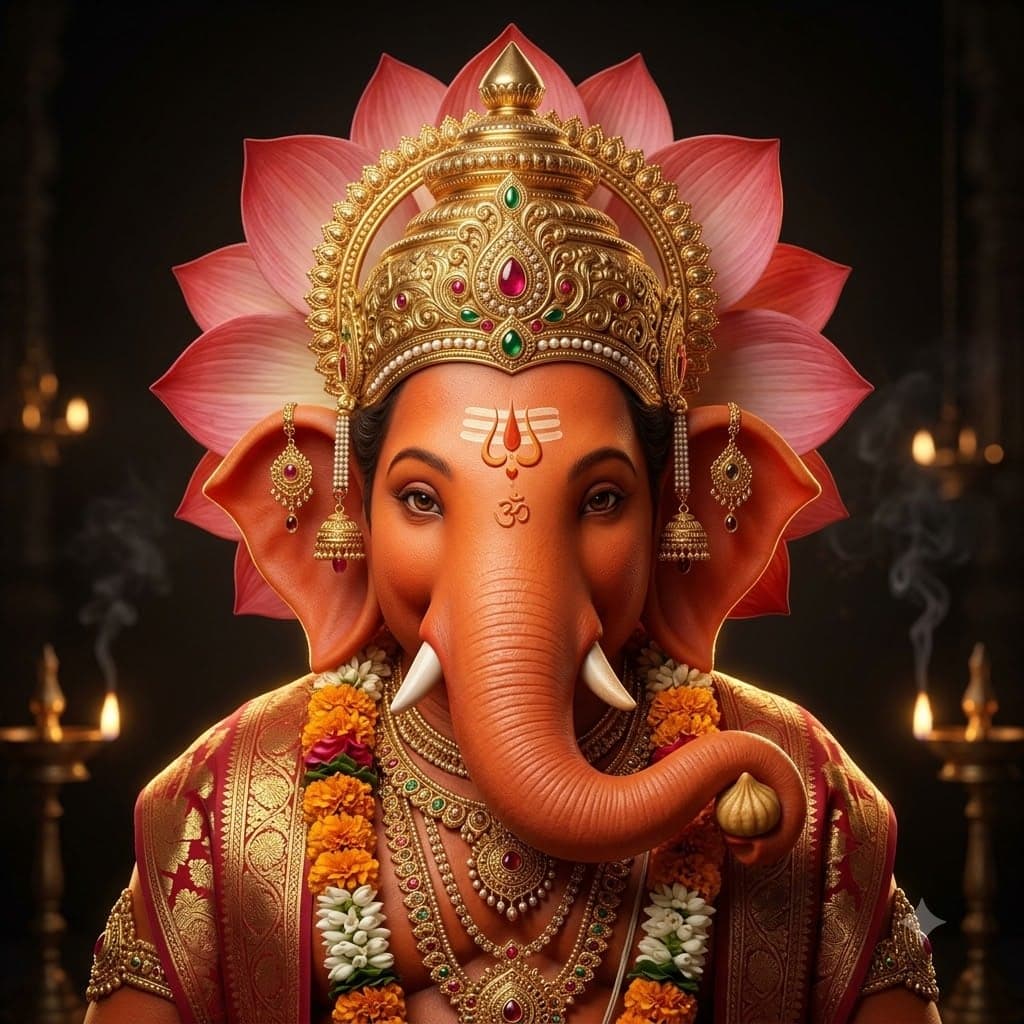
At a glance: Ganesh
- Also known as
- Ganesha, Ganapati, Vinayaka, Vighnaharta, Ekadanta, Gajanana, Lambodara, Vakratunda, Ganpati Bappa, Pillaiyar (Tamil Nadu)
- Family
- Son of Shiva and Parvati, brother of Kartikeya. Wives Siddhi and Buddhi (Shiva Purana), or Riddhi and Siddhi; sons Kshema (Shubh) and Labh. Many in South India hold him unmarried
- Shown with
- Elephant head with one tusk and a large belly; usually four arms holding a goad, a noose, a modak and his broken tusk or a lotus; red in colour; rides a mouse (mushak)
- Worshipped on
- Ganesh Chaturthi and Ganeshotsav, Ganesh Jayanti, monthly Sankashti and Vinayaki Chaturthi; Tuesday in Maharashtra, Wednesday in North India; worshipped first in every puja
- Holy places
- The Ashtavinayak: Morgaon, Siddhatek, Pali, Mahad, Theur, Lenyadri, Ozar, Ranjangaon; Siddhivinayak, Mumbai; Dagdusheth Halwai, Pune; Ganpatipule; Kanipakam
The story: Tulasi meets Ganesha by the Ganga
The Brahma Vaivarta Purana tells this story at the very end of its Ganapati Khanda (chapter 46). The sage Narayana has just told how Parashurama, after the fight in which he broke Ganesha’s tusk, praised Durga and, at Shiva’s bidding, worshipped Ganesha with incense, lamps, perfume, flowers and food, but “without tulasi” (तुलसीं विना). Narada asks the obvious question: tulasi is the most honoured of all flowers, so why does Ganesha not accept it? Narayana answers with an old and hidden tale which, he says, belongs to the Brahma kalpa.
Once the young Tulasi, devoted to Narayana, was travelling from one holy place to another as a penance. On the bank of the Ganga she saw the youthful Ganesha seated in meditation, smeared with sandal paste, dressed in yellow and adorned with jewels, his mind fixed on the lotus feet of Krishna. Tulasi was drawn to him. Laughing, she asked how he came by his elephant face, his great belly and his single tusk, told him it was evening and time to stop meditating, sprinkled water on him and poked him with the tip of her finger.
Ganesha opened his eyes and spoke gently: breaking an ascetic’s meditation brings sin, he said, but he prayed that Krishna would keep all harm from her. When Ganesha asked who she was, Tulasi said she was the daughter of “Dharma’s son” (धर्मात्मज), an unmarried girl doing penance to win a husband, and asked Ganesha to be that husband. Ganesha refused. Marriage, he told her, brings sorrow and never happiness; it breaks devotion to Hari, destroys penance and is the bolt on the door of liberation (मोक्षद्वारकपाटः). Ganesha advised her to look for a husband who wished to marry.
Tulasi, angry, cursed Ganesha to have a wife after all, the very thing he had refused. Ganesha cursed her in return: an asura would seize her, and later, by the curse of great beings, she would become a tree. Tulasi wept and praised him, and Ganesha relented. She would be the essence of all flowers, he said, the beloved of Narayana and dear to all the gods, above all to Krishna, and worship with her would give people liberation, “but never to be enjoyed by me” (मया भोग्या न नित्यशः). Ganesha then went to Badrikashrama to worship Hari, and Tulasi went to Pushkara, where she did penance for a hundred thousand years without food.
What the curses led to
Both curses came true, the Purana says. Because of Ganesha’s curse, Tulasi was for a long time the wife of the asura Shankhachuda; after Shiva killed him with his trident, Tulasi, dear to Narayana, became the tulsi plant (Ganapati Khanda 46). Her story with Shankhachuda and Vishnu, and how she came to be worshipped beside the Shaligram, is the story behind Tulsi Vivah.
The same Purana gives a second reason for that marriage. In its Prakriti Khanda, Tulasi is the daughter of King Dharmadhvaja and Queen Madhavi; she does penance at Badrikashrama to win Narayana, and Brahma tells her she must first marry Shankhachuda, the cowherd Sudama of Goloka reborn as an asura through Radha’s curse (Prakriti Khanda 15). The Ganapati Khanda does not mention this, and that Prakriti Khanda chapter does not mention Ganesha: the two passages explain the same marriage in different ways.
Chapter 46 does not say how Tulasi’s curse on Ganesha was fulfilled. Ganesha’s marriage to Siddhi and Buddhi, the daughters of Prajapati Vishvarupa, is told in another text, the Shiva Purana, with its own story and no curse (Rudra Samhita, Kumara Khanda 20).
What to offer Ganesha instead
The leaf that belongs to Ganesha is durva grass. The Shiva Purana, setting out Ganesha’s vrata, asks for worship with durva, and for twenty-one blades with three joints and no roots to be offered to the image (Rudra Samhita, Kumara Khanda 18.41–45). The Ganapati Atharvashirsha pictures Ganesha as red and worshipped with red flowers, and red hibiscus, sindoor and modaks fill his puja. The reasons for each are told in the Ganesh Chaturthi story of why durva, modak and red flowers are offered to Ganesha.
In Maharashtra the difference is easy to see. Tulsi belongs to Vishnu and his forms: the aarti of Vitthal of Pandharpur, “Yuge atthavis vitevari ubha”, pictures him with a garland of tulsi at his neck (“तुळसीमाळा गळां”), and Varkari pilgrims wear malas of tulsi beads. Ganpati is given bunches and garlands of durva, especially on Tuesdays and on Sankashti. The tulsi in the courtyard vrindavan is worshipped every day, but its leaves go to Vishnu, Krishna and Vitthal, and Ganpati gets durva.
What is popular belief, not scripture
Many retellings, especially in Hindi, say that Tulasi cursed Ganesha with two marriages, and that Ganesha told her by name that she would marry Shankhachuda. The Sanskrit of the Brahma Vaivarta Purana says otherwise: Tulasi’s curse is a single wife (दारास्ते भविता, “you will have a wife”), whom the English and Telugu translations take to be an unworthy one, and Ganesha speaks only of “an asura”; it is the narrator, Narayana, who names Shankhachuda later.
The story is also often credited to the Ganesha Purana. The telling followed here, and by the popular retellings, with the bank of the Ganga and the daughter of “Dharma’s son”, is the one in the Brahma Vaivarta Purana’s Ganapati Khanda.
Many families also say that tulsi may be offered to Ganesha on one day only, Ganesh Chaturthi. That is a custom of the puja, not of the Purana. Many lists of the twenty-one leaves (patri) offered in the Ganesh Chaturthi puja include tulsi, and the Kanchi Kamakoti Peetham’s list for Vinayaka Chaturthi offers it with the mantra “ॐ गजवक्त्राय नमः तुलसीपत्रं समर्पयामि”, calling the day an exception. The Brahma Vaivarta Purana makes no exception: Ganesha says “never”. Families that include tulsi in the Chaturthi patri and families that keep it away from Ganesha altogether are each following their own tradition.
Festivals of this story
Aartis and bhajans of Ganesh
- Aala Majha Mumbaicha Raja
- Jhale Bhajan (Nirop Aarti) - Aamhi Namito Tav Charan
- Sukhkarta Dukhharta
- Lalbaugcha Raja (Song)
- Gajanana Ba Dayasagara
- Ghalin Lotangan Vandin Charan
- Jai Ganesh Jai Ganesh Deva
- Parvatichya Bala (Aala Re Aala Ganpati Aala)
Frequently asked questions
Why Is Tulsi Not Offered to Ganesha? The Story of Two Curses
Tulsi is not offered to Ganesha because of a story in the Brahma Vaivarta Purana: the young Tulasi asked Ganesha to marry her, he refused, and they cursed each other. Relenting, Ganesha blessed her to become the plant dearest to Vishnu and Krishna, but said he would never accept her himself.
What are the other names of Ganesh?
Ganesha, Ganapati, Vinayaka, Vighnaharta, Ekadanta, Gajanana, Lambodara, Vakratunda, Ganpati Bappa, Pillaiyar (Tamil Nadu)
What other stories are told about Ganesh?
Why Does Ganesha Have an Elephant Head? What the Puranas Say; Why Is Ganesha’s Tusk Broken? The Story of Ekadanta; Why Is the Mouse Ganesha’s Vahana? The Story of Mushaka; Who Are Ganesha’s Wives? Riddhi, Siddhi and Buddhi; What Are the Ashtavinayak Temples? The Legend of Each Ganpati. Each is on Dharmasthan with its sources, in English, Hindi and Marathi.
Sources
- Brahma Vaivarta Purana, Ganapati Khanda, ch. 46 (Nag Publishers tr.): Narada’s question; Tulasi and Ganesha by the Ganga, the two curses, Ganesha’s blessing and refusal; Tulasi as Shankhachuda’s wife and then the tulsi plant Read the text
- Brahma Vaivarta Purana, Ganapati Khanda, ch. 46, Sanskrit text with Telugu translation: The Sanskrit words quoted: तुलसीं विना, धर्मात्मजस्य कन्या, मोक्षद्वारकपाटः, दारास्ते भविता, मया भोग्या न नित्यशः Read the text
- Brahma Vaivarta Purana, Prakriti Khanda, ch. 15 (Nag Publishers tr.): Tulasi born to King Dharmadhvaja and Madhavi; her penance at Badrikashrama and Brahma’s word that she will first marry Shankhachuda Read the text
- Shiva Purana, Rudra Samhita, Kumara Khanda, ch. 18 and 20 (J. L. Shastri tr.): Durva in Ganesha’s vrata, twenty-one blades for the image (18.41–45); Ganesha’s marriage to Siddhi and Buddhi (ch. 20) Read the text
- Sri Kanchi Kamakoti Peetham, “Vinayaka Chaturti Puja: 21 Sacred Leaves for Archana” (2021): Tulasi among the twenty-one leaves of Vinayaka Chaturthi, with its mantra; the day called an exception to the usual rule Read the text
- Drik Panchang, “21 Patras for Ganesh Puja”: Tulsi (Marathi तुळस) in the list of twenty-one patri for Ganesh Chaturthi, offered on that day as an exception Read the text