
Stories of Ganesh
Why Is Ganesha’s Tusk Broken? The Story of Ekadanta
By the Dharmasthan team · Updated · 7 sources cited
Ganesha has one tusk, and is called Ekadanta, because Parashurama’s axe cut off his left tusk when Ganesha stopped him at Shiva’s door, as the Brahmanda and Brahma Vaivarta Puranas tell. The Skanda Purana says instead that Ganesha pulled out the tusk himself to hold as a yogi’s staff.
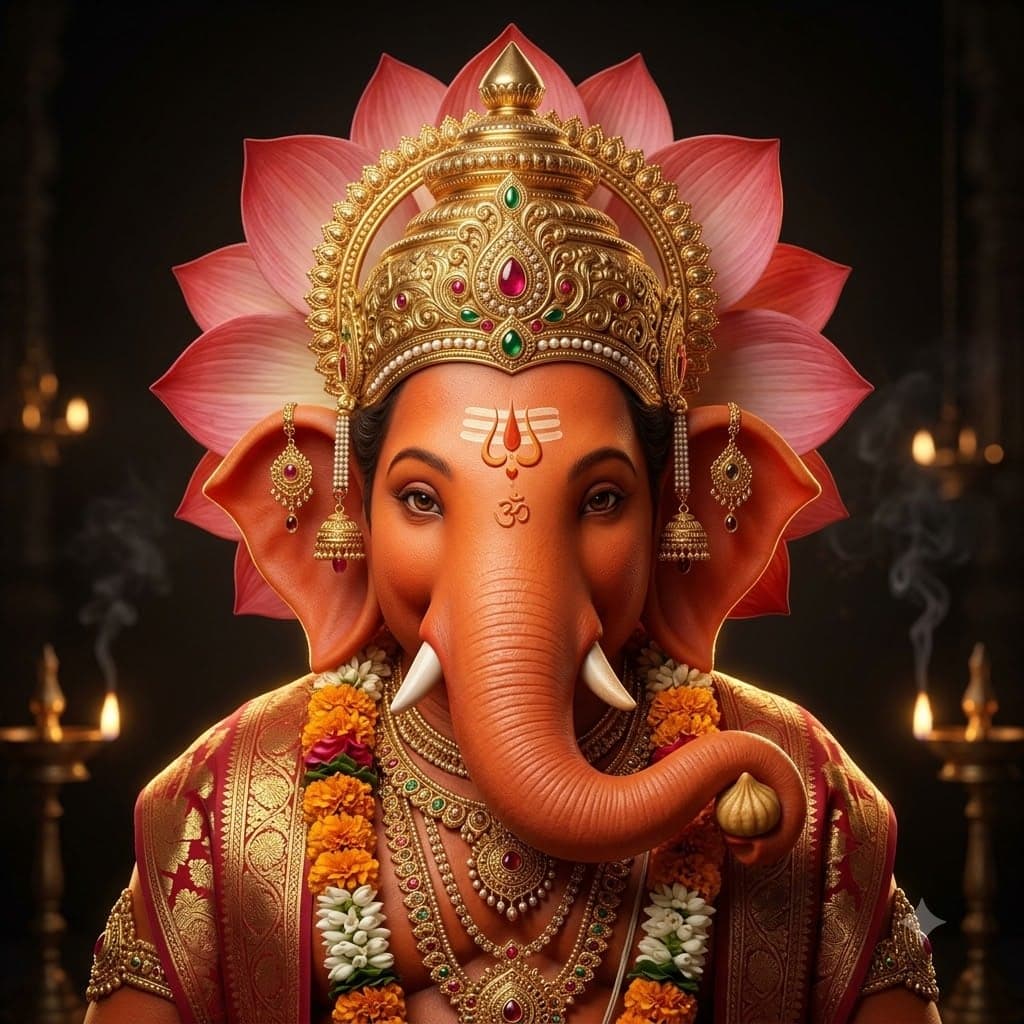
At a glance: Ganesh
- Also known as
- Ganesha, Ganapati, Vinayaka, Vighnaharta, Ekadanta, Gajanana, Lambodara, Vakratunda, Ganpati Bappa, Pillaiyar (Tamil Nadu)
- Family
- Son of Shiva and Parvati, brother of Kartikeya. Wives Siddhi and Buddhi (Shiva Purana), or Riddhi and Siddhi; sons Kshema (Shubh) and Labh. Many in South India hold him unmarried
- Shown with
- Elephant head with one tusk and a large belly; usually four arms holding a goad, a noose, a modak and his broken tusk or a lotus; red in colour; rides a mouse (mushak)
- Worshipped on
- Ganesh Chaturthi and Ganeshotsav, Ganesh Jayanti, monthly Sankashti and Vinayaki Chaturthi; Tuesday in Maharashtra, Wednesday in North India; worshipped first in every puja
- Holy places
- The Ashtavinayak: Morgaon, Siddhatek, Pali, Mahad, Theur, Lenyadri, Ozar, Ranjangaon; Siddhivinayak, Mumbai; Dagdusheth Halwai, Pune; Ganpatipule; Kanipakam
Parashurama at Shiva’s door
The Brahmanda Purana tells the story in its account of Parashurama (Upodghata Pada, chapters 41–42). After his war with King Kartavirya’s sons, Parashurama went to Kailasa to bow to Shiva, his guru (41.15–17). At the palace door sat Kartikeya and Ganesha. Ganesha asked him to wait while Shiva rested with Parvati (41.31–37). Parashurama would not wait, the argument became a scuffle, Skanda pulled them apart, and Parashurama raised his axe (41.51–53). Ganesha lifted him in his hand, whirled him through the heavens and nether worlds, dropped him in the ocean and set him back where he stood (41.54–55).
Furious, Parashurama hurled the axe (42.2). Ganesha saw that it was the axe Shiva himself had given Parashurama and, so that his father’s gift should not go in vain, took the blow on his left tusk (42.3). The tusk fell, covered in blood, like a mountain struck by Indra’s thunderbolt, and the earth shook (42.4–5). Parvati came out, saw her son with one tusk and told Shiva bitterly that his disciple had paid his guru’s fee by cutting off his son’s tusk; she would leave for her father’s house (42.7–17).
Shiva called Krishna to mind, and Krishna came with Radha (42.17–23). Explaining Ganesha’s names, Krishna told Parvati that today Parashurama had made him Ekadanta, the one-tusked (42.39). Radha took Ganesha on her lap and the wound healed at her touch (42.51–52), and Parvati took Parashurama on her lap too (42.53–55).
The Brahma Vaivarta Purana’s telling
The Brahma Vaivarta Purana tells it at greater length (Ganapati Khanda). Its chapter 24, “The reason for Ganesha having a single tusk”, opens with Narada asking where the second tusk went, since the elephant whose head Ganesha received had two; the answer runs to chapter 45. Here Ganesha winds his trunk round Parashurama and carries him through the worlds to Krishna in Goloka. When Parashurama throws the axe, Ganesha sees that it is Shiva’s weapon and will not make it fruitless: he takes it on his left tusk, which falls with a thundering crash (chapter 43).
Parvati weeps over her son, rebukes Parashurama for turning his guru’s axe on his guru’s son and is about to curse him when Vishnu arrives as a radiant Brahmin boy. Vishnu tells her that the Vedas know her son as Ekadanta and teaches a hymn of his eight names, which reads eka as “foremost” and danta as “strength” (chapters 43–44). Parashurama praises Durga, and Parvati blesses him (chapter 45).
Other versions in the Puranas
In the Shiva Purana the tusk never breaks: the head the gods brought for Parvati’s son came from “a single-tusked elephant” (Rudra Samhita, Kumara Khanda 17.49), a story told in “Why Does Ganesha Have an Elephant Head?”. In the Skanda Purana, after Shiva revives Ganesha with an elephant’s head, Ganesha sits in meditation and pulls out his own tusk to hold as a yogadanda, a yogi’s staff (Maheshvara Khanda, Kedara Khanda 10.34–37). Its translator, G. V. Tagare, notes the contrast with the Brahmanda Purana, where the axe cuts it.
The Mudgala Purana, a Purana of Ganesha’s devotees, the Ganapatyas, makes Ekadanta one of his eight avatars, the hero of its second book. Ekadanta, riding a mouse, fights Madasura, the demon of mada, pride and intoxication. Struck down by Ekadanta’s axe, Madasura realises that Ekadanta is Brahman itself (2.53) and surrenders. Ekadanta spares him on terms: Madasura must leave alone any work begun by remembering Ganesha first, and may devour only the fruit of work begun without him (2.54). The same book reads the name itself: eka is maya, the play of the world, and danta is pure being, so Ekadanta is the one who holds maya (2.52.13–14).
The popular tellings
The best-known answer today is that Ganesha snapped off his tusk to use as a pen when his own broke while Vyasa dictated the Mahabharata. That is a popular telling. The Mahabharata’s own account has two conditions, that Ganesha’s pen must never stop and that he must write nothing he has not understood, but no tusk (Adi Parva, chapter 1); the story is told in “How Did Ganesha Write the Mahabharata?”.
Two other tellings are popular too. In one, Ganesha threw his tusk at the Moon, who had laughed at him; the Ganesha Purana tells of the Moon’s laughter and Ganesha’s curse, the story behind the Sankashti fast, but has no thrown tusk (Upasana Khanda 62). In Tamil Nadu a story is told of the demon Gajamukhasura, whom no weapon could kill: Ganesha broke off his tusk and hurled it at him, and the demon became the mouse Ganesha rides. We have not found it in a Sanskrit Purana; the mouse’s stories are in “Why Is the Mouse Ganesha’s Vahana?”.
The broken tusk in his hand
The Ganapati Atharvashirsha carries the name into worship. Its gayatri begins “एकदन्ताय विद्महे वक्रतुण्डाय धीमहि”, “may we know the one-tusked, may we meditate on the one with the curved trunk”, and its meditation verse pictures him one-tusked and four-handed, holding a noose, a goad, his tusk and the gesture of giving boons (“एकदन्तं चतुर्हस्तं पाशमङ्कुशधारिणम् । रदं च वरदं हस्तैर्…”). Many images show him so, with the broken tusk in one hand. Among the Ganesha Purana’s thousand names he is the one “whose left tusk is broken” (Upasana Khanda 46).
Each text draws its own lesson. In the Brahmanda Purana Ganesha takes the blow out of respect for his father’s gift, and Krishna calls him one whom anger and fear never touch (42.30–32); in the Brahma Vaivarta Purana Vishnu calls him the most self-controlled of the gods (chapter 44). For the Skanda Purana the tusk is a yogi’s staff, for the Mudgala Purana a victory over pride, and in the popular telling a sacrifice made so that a sacred book could be written.
In Maharashtra, Ekadanta is the second of the twelve names in the Sankatanashana stotra, “प्रथमं वक्रतुण्डं च एकदन्तं द्वितीयकम्”, and the aarti “Jai Ganesh Deva”, sung in homes and Ganeshotsav pandals, hails him as “एक दंत दयावंत चार भुजा धारी”, the kind one-tusked god with four arms.
Aartis and bhajans of Ganesh
- Aala Majha Mumbaicha Raja
- Jhale Bhajan (Nirop Aarti) - Aamhi Namito Tav Charan
- Sukhkarta Dukhharta
- Lalbaugcha Raja (Song)
- Gajanana Ba Dayasagara
- Ghalin Lotangan Vandin Charan
- Jai Ganesh Jai Ganesh Deva
- Parvatichya Bala (Aala Re Aala Ganpati Aala)
Frequently asked questions
Why Is Ganesha’s Tusk Broken? The Story of Ekadanta
Ganesha has one tusk, and is called Ekadanta, because Parashurama’s axe cut off his left tusk when Ganesha stopped him at Shiva’s door, as the Brahmanda and Brahma Vaivarta Puranas tell. The Skanda Purana says instead that Ganesha pulled out the tusk himself to hold as a yogi’s staff.
What are the other names of Ganesh?
Ganesha, Ganapati, Vinayaka, Vighnaharta, Ekadanta, Gajanana, Lambodara, Vakratunda, Ganpati Bappa, Pillaiyar (Tamil Nadu)
What other stories are told about Ganesh?
Why Does Ganesha Have an Elephant Head? What the Puranas Say; Why Is Tulsi Not Offered to Ganesha? The Story of Two Curses; Why Is the Mouse Ganesha’s Vahana? The Story of Mushaka; Who Are Ganesha’s Wives? Riddhi, Siddhi and Buddhi; What Are the Ashtavinayak Temples? The Legend of Each Ganpati. Each is on Dharmasthan with its sources, in English, Hindi and Marathi.
Sources
- Brahmanda Purana, Upodghata Pada, ch. 41–42 (G. V. Tagare tr.): Ganesha stops Parashurama at Shiva’s door and whirls him through the worlds (41.15–55); the axe, Shiva’s gift, cuts off his left tusk (42.2–5); Parvati’s anger, Krishna names him Ekadanta (42.39) and Radha heals the wound (42.51–52) Read the text
- Brahma Vaivarta Purana, Ganapati Khanda, ch. 24 and 42–45: Narada asks where the second tusk went (ch. 24); Ganesha takes Parashurama’s axe on his left tusk (ch. 43); Parvati’s rebuke, Vishnu and the eight names (ch. 44); Parvati blesses Parashurama (ch. 45) Read the text
- Skanda Purana, Maheshvara Khanda, Kedara Khanda, ch. 10 (G. V. Tagare tr.): Ganesha, revived with an elephant’s head, pulls out his own tusk as a yogadanda (10.34–37); Tagare’s note contrasting the Brahmanda Purana Read the text
- Shiva Purana, Rudra Samhita, Kumara Khanda, ch. 17 (J. L. Shastri tr.): The head is that of a single-tusked elephant (17.49) Read the text
- Mudgala Purana, Khanda 2 (Ekadanta-charita), ch. 52–54 (Sanskrit text): Ekadanta’s meditation verse and the meaning of eka and danta (52.9–14); Madasura struck down by the axe (53) and spared (54) Read the text
- Mahabharata, Adi Parva, ch. 1 (K. M. Ganguli tr., Section I): Ganesha as Vyasa’s scribe and the two conditions; no tusk Read the text
- Ganesha Purana, Upasana Khanda, ch. 46 and 62 (G. Bailey tr., Motilal Banarsidass): Among the thousand names, “whose left tusk is broken” (46); the Moon laughs and is cursed, with no thrown tusk (62)