
Stories of Ganesh
Why Does Ganesha Have an Elephant Head? What the Puranas Say
By the Dharmasthan team · Updated · 7 sources cited
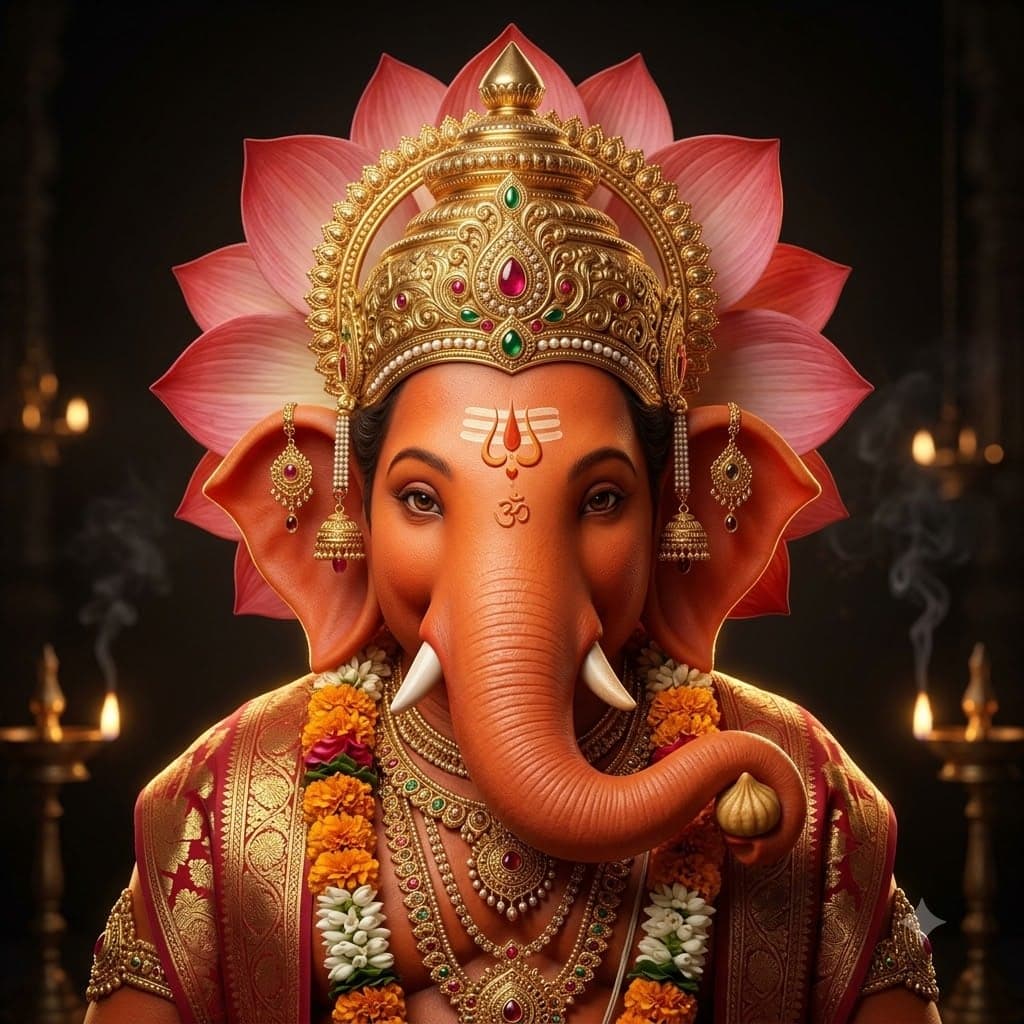
Ganesha has an elephant head because, in the Shiva Purana, Shiva cut off his head and the gods brought him the head of the first creature they met in the north, a single-tusked elephant. Other Puranas tell it differently: Shani’s glance, Rudra’s curse, or a face he was born with.
At a glance: Ganesh
- Also known as
- Ganesha, Ganapati, Vinayaka, Vighnaharta, Ekadanta, Gajanana, Lambodara, Vakratunda, Ganpati Bappa, Pillaiyar (Tamil Nadu)
- Family
- Son of Shiva and Parvati, brother of Kartikeya. Wives Siddhi and Buddhi (Shiva Purana), or Riddhi and Siddhi; sons Kshema (Shubh) and Labh. Many in South India hold him unmarried
- Shown with
- Elephant head with one tusk and a large belly; usually four arms holding a goad, a noose, a modak and his broken tusk or a lotus; red in colour; rides a mouse (mushak)
- Worshipped on
- Ganesh Chaturthi and Ganeshotsav, Ganesh Jayanti, monthly Sankashti and Vinayaki Chaturthi; Tuesday in Maharashtra, Wednesday in North India; worshipped first in every puja
- Holy places
- The Ashtavinayak: Morgaon, Siddhatek, Pali, Mahad, Theur, Lenyadri, Ozar, Ranjangaon; Siddhivinayak, Mumbai; Dagdusheth Halwai, Pune; Ganpatipule; Kanipakam
The best-known telling: the Shiva Purana
The best-known answer comes from the Shiva Purana (Rudra Samhita, Kumara Khanda, chapters 13–17), and the Ganesh Chaturthi story tells it in full. Parvati shapes a son from the dirt of her body and sets him at her door; when he bars Shiva’s way, Shiva cuts off his head with his trident (16.34). To calm Parvati’s fury, Shiva sends the gods north to bring the head of the first creature they meet. It is a single-tusked elephant, and Ganesha wakes to life red-complexioned, with the face of an elephant (17.47–57).
The Shiva Purana itself says this is not the only telling. Ganesha’s birth, it says, is told differently in different kalpas, the ages of creation, and in one of them his head was cut off when Shani looked at him, and an elephant’s head was put in its place (13.5). Its own story, it adds, belongs to the Shvetakalpa (13.6).
Shani’s glance and Vishnu’s elephant: the Brahma Vaivarta Purana
The telling with Shani is found in the Brahma Vaivarta Purana’s Ganapati Khanda. Here Ganesha is not shaped by Parvati. After she keeps the Punyaka vrata for a son, Vishnu comes to her door as a hungry old brahmin, tells her that in every kalpa Krishna becomes her son as Ganesha, and then appears on her bed as a newborn child (chapter 8).
When Shani, the son of Surya, comes to see the baby, he keeps his eyes lowered and explains that his wife once cursed him that whatever he looked at would be destroyed (chapter 11). Parvati laughs and asks him to look. He glances at the child from the corner of his right eye, and the head is severed and goes to Goloka, into Krishna. Vishnu rides Garuda north to the Pushpabhadra river, finds an elephant lying with its head to the north, cuts off its head with the Sudarshana chakra and joins it to the child, who comes back to life. Vishnu also restores the elephant to life (chapter 12).
The Brahma Vaivarta Purana gives two deeper reasons. Asked how the remover of obstacles could meet an obstacle himself, it says that Shiva had once struck down Surya with his trident, and Surya’s father Kashyapa cursed Shiva that his own son’s head would be cut off in the same way (chapter 18). As for why an elephant, the Purana tells of Indra. The sage Durvasa gave him a parijata flower from Narayana: whoever wore it on his head would be worshipped first of all. Indra, proud of his fortune, tossed it onto the head of the elephant he rode and lost his glory, and it was this elephant’s head that Vishnu later gave to Ganesha (chapter 20). The text does not name the elephant.
Born with an elephant face: the Varaha and Linga Puranas
In the Varaha Purana no head is lost (chapter 23). Seeing that good people’s work meets obstacles while the wicked succeed, the gods ask Rudra for a being who will obstruct the wicked (23.3–7). Rudra laughs, and from his laughter a radiant boy arises, so beautiful that Uma cannot take her eyes off him (23.11–16). Angered, Rudra curses the boy to have an elephant’s face, a protruding belly and a sacred thread of serpents (23.18). He names him Vinayaka, Vighnakara, Ganesha and Bhavaputra, and the boy becomes Uma’s son. All this happened on Chaturthi, the Purana says, and on that tithi Ganesha is to be worshipped, eating only sesame (23.28–37).
In the Linga Purana, too, Ganesha is elephant-faced from birth (Purva Bhaga, chapters 104–105). The gods ask Shiva for Vighnesha, a lord of obstacles who will hinder the rites of the daityas (104.2–6). Shiva creates Ganeshvara, and Ambika welcomes him as the elephant-faced Gajanana (105.7–10). Shiva tells his son that he must be worshipped at the start of every rite, and that a rite begun without him will turn inauspicious (105.22–23).
In battle and in the Ganga: the Skanda and Matsya Puranas
The Skanda Purana tells yet another version (Maheshvara Khanda, Kedara Khanda 10.28–35). Ganesha is born of Prakriti, the primal Shakti, and, not knowing Shiva, fights him. Seeing that the boy cannot be beaten while he rides an elephant, Shiva strikes down rider and elephant together with his trident. When Shakti asks him to revive her son, Shiva laughs, brings him back to life and fixes an elephant’s head on his body. The same chapter goes on to his broken tusk, the story of Ekadanta.
The Matsya Purana tells of a playful birth (154.501–505). Parvati, rubbing her body with scented oil and powder, shapes an elephant-faced figure from the paste and, in play, puts it into the waters of the Ganga, where it grows until it fills the world. Parvati calls him “son”, and the Ganga calls him “son” too, so the gods worship him as Gangeya, and Brahma makes him lord of the Vinayakas. Here too the elephant face is his from the start.
What is popular belief, and what the versions share
A popular telling says the head belonged to Gajasura, an elephant demon. That is not in the Shiva Purana, which says only that the gods met a single-tusked elephant (Kumara Khanda 17.49). The Shiva Purana does tell of Gajasura, but as a separate story of Shiva: Shiva slays him at Kashi and wears his hide as Krittivasas (Rudra Samhita, Yuddha Khanda 57). Some also link the custom of not sleeping with one’s head to the north to this story; none of these Puranas makes any such rule.
Different as they are, the versions agree on what the elephant-headed god is for. In the Shiva Purana he is made lord of the ganas and worshipped before all the gods (18.8, 18.23–31); in the Varaha and Linga Puranas he is created to obstruct the wicked and to be honoured first; in the Brahma Vaivarta Purana his head comes from the elephant that wore the flower of first worship. The Yajnavalkya Smriti describes Vinayaka in the same terms with no story of a head: appointed by Rudra and Brahma as lord of the ganas, to obstruct undertakings and to bring them success (1.271). In Maharashtra he is Gajanana, the elephant-faced, invoked first in every puja and new beginning.
Festivals of this story
Aartis and bhajans of Ganesh
- Aala Majha Mumbaicha Raja
- Jhale Bhajan (Nirop Aarti) - Aamhi Namito Tav Charan
- Sukhkarta Dukhharta
- Lalbaugcha Raja (Song)
- Gajanana Ba Dayasagara
- Ghalin Lotangan Vandin Charan
- Jai Ganesh Jai Ganesh Deva
- Parvatichya Bala (Aala Re Aala Ganpati Aala)
Frequently asked questions
Why Does Ganesha Have an Elephant Head? What the Puranas Say
Ganesha has an elephant head because, in the Shiva Purana, Shiva cut off his head and the gods brought him the head of the first creature they met in the north, a single-tusked elephant. Other Puranas tell it differently: Shani’s glance, Rudra’s curse, or a face he was born with.
What are the other names of Ganesh?
Ganesha, Ganapati, Vinayaka, Vighnaharta, Ekadanta, Gajanana, Lambodara, Vakratunda, Ganpati Bappa, Pillaiyar (Tamil Nadu)
What other stories are told about Ganesh?
Why Is Ganesha’s Tusk Broken? The Story of Ekadanta; Why Is Tulsi Not Offered to Ganesha? The Story of Two Curses; Why Is the Mouse Ganesha’s Vahana? The Story of Mushaka; Who Are Ganesha’s Wives? Riddhi, Siddhi and Buddhi; What Are the Ashtavinayak Temples? The Legend of Each Ganpati. Each is on Dharmasthan with its sources, in English, Hindi and Marathi.
Sources
- Shiva Purana, Rudra Samhita, Kumara Khanda 13, 16–18, and Yuddha Khanda 57 (J. L. Shastri tr., Motilal): Ganesha’s birth told differently in different kalpas, Shani’s glance in one of them (13.5–6); the head cut off (16.34); the single-tusked elephant met to the north (17.47–57); worshipped first (18.8, 18.23–31); Gajasura slain at Kashi, a separate story (Yuddha Khanda 57) Read the text
- Brahma Vaivarta Purana, Ganapati Khanda, chapters 8, 11, 12, 18 and 20 (English translation on Vedic People): Born by Krishna’s grace after the Punyaka vrata (8); Shani’s curse and glance (11–12); Vishnu brings the head of an elephant from the Pushpabhadra river (12); Kashyapa’s curse on Shiva (18); Indra, Durvasa’s parijata and the elephant (20) Read the text
- Varaha Purana, chapter 23, “The Origin of Vinayaka” (English translation on Vedic People): Born of Rudra’s laughter; Rudra’s curse of the elephant face, belly and serpent thread (23.11–18); his names; Chaturthi his tithi (23.28–37) Read the text
- Linga Purana, Purva Bhaga 104–105 (Motilal, ed. J. L. Shastri): The gods ask for Vighnesha to obstruct the daityas (104.2–6); Shiva creates the elephant-faced Gajanana; worshipped at the start of every rite (105.7–23). Wisdomlib labels this part “Uttarabhāga” by mistake Read the text
- Skanda Purana, Maheshvara Khanda, Kedara Khanda 10 (G. V. Tagare tr., Motilal): Ganesha born of Prakriti fights Shiva on an elephant, is felled with it and revived with an elephant’s head (10.28–35) Read the text
- Matsya Purana 154.501–505 (Sanskrit, GRETIL; English by “a Taluqdar of Oudh”, Sacred Books of the Hindus XVII, part II): Parvati shapes an elephant-faced figure from her unguent and puts it in the Ganga; Parvati and Ganga call him son; worshipped as Gangeya and made lord of the Vinayakas Read the text
- Yajnavalkya Smriti 1.271 (Sanskrit, GRETIL): Vinayaka appointed by Rudra and Brahma as lord of the ganas, to obstruct and to give success to undertakings; no elephant head mentioned Read the text