
Stories of Ganesh
Why Is the Mouse Ganesha’s Vahana? The Story of Mushaka
By the Dharmasthan team · Updated · 7 sources cited
Ganesha rides a mouse because, in the Ganesha Purana, his avatar Gajanana caught a giant mouse, the cursed gandharva Krauncha, with his noose and made it his vahana. In the Brahma Vaivarta Purana the Earth gives him the mouse, and the Mudgala Purana reads it as the Lord hidden like a thief in every heart.
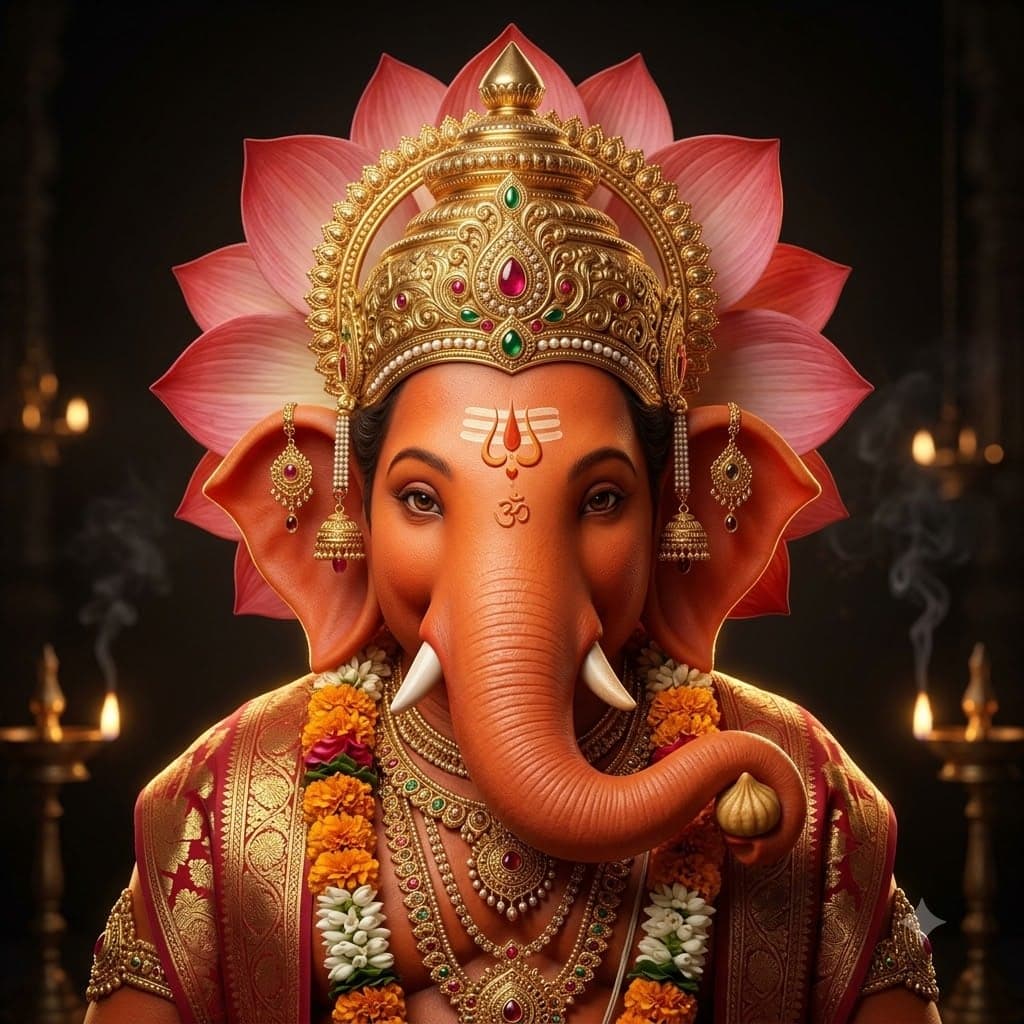
At a glance: Ganesh
- Also known as
- Ganesha, Ganapati, Vinayaka, Vighnaharta, Ekadanta, Gajanana, Lambodara, Vakratunda, Ganpati Bappa, Pillaiyar (Tamil Nadu)
- Family
- Son of Shiva and Parvati, brother of Kartikeya. Wives Siddhi and Buddhi (Shiva Purana), or Riddhi and Siddhi; sons Kshema (Shubh) and Labh. Many in South India hold him unmarried
- Shown with
- Elephant head with one tusk and a large belly; usually four arms holding a goad, a noose, a modak and his broken tusk or a lotus; red in colour; rides a mouse (mushak)
- Worshipped on
- Ganesh Chaturthi and Ganeshotsav, Ganesh Jayanti, monthly Sankashti and Vinayaki Chaturthi; Tuesday in Maharashtra, Wednesday in North India; worshipped first in every puja
- Holy places
- The Ashtavinayak: Morgaon, Siddhatek, Pali, Mahad, Theur, Lenyadri, Ozar, Ranjangaon; Siddhivinayak, Mumbai; Dagdusheth Halwai, Pune; Ganpatipule; Kanipakam
Gajanana and the giant mouse
The fullest answer comes from the Ganesha Purana, a medieval Purana of Ganesha’s own devotees, the Ganapatyas. Its Krida Khanda gives Ganesha one avatar for each age of the world, each with its own mount, and the avatar of the Dvapara age rides a mouse (Krida Khanda 1.17–21). He is Gajanana, red and four-armed, born to Parvati (chapter 130). Taken to the queen of King Varenya and abandoned in the forest because of his elephant face, the child is found by the sage Parashara, who raises him with his wife Vatsala (chapters 131–133).
Asked how the mouse became Ganesha’s vehicle (134.3), Brahma retells a story the sage Shukra once told Prahlada. In Indra’s court a gandharva named Krauncha, in a hurry, struck the sage Vamadeva with his toes. Vamadeva cursed him to become a mouse, but added that Ganesha would one day ride him and lead him to liberation (134.7–9). Krauncha fell into Parashara’s hermitage as a mouse the size of a mountain. It ate the stored grain, smashed the clay pots, devoured books, clothes and bark garments, and knocked down trees with its tail (134.10–13).
Seeing Parashara in despair, the child Gajanana threw his noose. It flashed like lightning down to Patala, the netherworld, and dragged the mouse out bound by the neck (134.18–28). The mouse recognised the Lord and praised him. When Gajanana offered it a boon, the proud mouse said it wanted nothing: Gajanana should ask a boon of it instead. “Then become my vehicle,” said Gajanana, and climbed on. Crushed under his weight, the mouse begged him to be lighter, and Ganesha made himself light (134.34–40). On this mouse Gajanana later rode out against the demon Sindura (chapter 136).
Other tellings of the mouse’s origin
The very next chapter tells the curse another way (Krida Khanda 135). Here Krauncha comes to the hermitage of the sage Saubhari on Mount Meru and, while the sage is away fetching firewood, seizes the hand of his wife Manomayi. Saubhari returns and curses him: because he acted behind the sage’s back, he will become a mouse that digs through the earth and fills its belly like a thief (135.27). Relenting, Saubhari promises that when Ganesha is born as Gajanana in Parashara’s house, Krauncha will become his vehicle and then regain heaven (135.33–35). Popular retellings usually give only Vamadeva’s curse.
The Brahma Vaivarta Purana gives a simpler answer. When Ganesha was named, the gods brought him gifts: Brahma a water pot, Indra a jewelled throne, Kubera a crown, and the goddess Earth a mouse to be his vehicle (Ganapati Khanda 13).
A South Indian legend, recorded by Alice Getty in 1936, links the mouse to Ganesha’s broken tusk. Gajamukhasura, an elephant-faced demon whom neither god nor man could defeat, broke off Ganesha’s right tusk in battle. Ganesha hurled the tusk at him, the demon turned into a mouse, and Ganesha took him as his vahana (Getty, p. 15). Modern retellings also name a demon Mushikasura who became the mount; we have not found that story in a Purana.
The thief within: the Mudgala Purana
The Mudgala Purana, the other great Ganapatya Purana, tells of eight avatars of Ganesha, each defeating a demon who stands for a vice. Four of them ride the mouse: Ekadanta, Mahodara, Gajanana and Lambodara (Khandas 2–5). In the Lambodara section Ganesha, born as the son of the serpent Shesha to destroy the demon Mayakara, asks for a vehicle made of the four gods. The gods give it portions of themselves, a strong mouse comes to life, and Brahma consecrates it (5.19.18–37).
Shiva’s words there are the Purana’s own answer. The word mushaka, he says, comes from the root mush, “to steal” (5.19.24). The Lord who enjoys every pleasure in the world of names and forms stays hidden by maya, so beings think they themselves are the enjoyers: he enjoys like a thief, unseen. That hidden enjoyer is the mouse, and it is to be Ganesha’s vehicle (5.19.25–32). In Skanda’s hymn it is Ganesha himself who dwells in devotees’ hearts like a thief, “therefore the mouse became your vehicle” (3.5.41–43). The Purana adds that when devotees remember him, Ganesha of the mouse banner carries off the stain of their merit and sin (5.21.57).
History, meaning and the mouse in Maharashtra
The mouse came late to Ganesha’s images. The earliest elephant-headed images, from about the fourth to the seventh century, show no mouse (Thapan, p. 119). The scholar Yuvraj Krishan found that it becomes common only in later sculpture, as on the Mukteshvara temple at Bhubaneswar of the tenth or eleventh century, and that several early texts never mention it (Krishan 1981, pp. 288–289); Getty wrote that it did not reach South India before the twelfth century. Yet the Matsya Purana’s chapter on images describes Ganesha riding a mouse (260.52–55), and the Ganapati Atharvashirsha shows it on his banner: “bibhranam mushakadhvajam” (verse 9).
Scholars’ readings are interpretations, not scripture. B. A. Gupte, writing in 1906, took Mushakavahana to mean the Lord of the Harvest who overcomes the field mouse, thief of the crops (cited by Getty, pp. 15–16). Alfred Foucher thought the mouse recalls a well-filled granary, as Kubera’s mongoose stands for a full purse. Anita Raina Thapan links it with the earth it burrows in, and with the Earth’s gift in the Brahma Vaivarta Purana (pp. 240–241). Many devotees today call the mouse the restless mind or desire that Ganesha rides and controls; that is a popular devotional reading.
Both Ganapatya Puranas are closely tied to Maharashtra. Thapan thinks they took their present form around the sixteenth century at one of Ganapati’s holy places there; the Ganesha Purana was first printed in Pune and Bombay in 1876, and the Yogindra Math at Morgaon has published its own edition (pp. 30–33). In Maharashtra’s Ganapati temples a small image of the mouse faces the main image; it is bathed, marked with sandal paste, decked with flowers and often coated with sindur, like Ganesha himself (Thapan, p. 220). At Ganeshotsav the mouse sits at the feet of almost every murti.
Aartis and bhajans of Ganesh
- Aala Majha Mumbaicha Raja
- Jhale Bhajan (Nirop Aarti) - Aamhi Namito Tav Charan
- Sukhkarta Dukhharta
- Lalbaugcha Raja (Song)
- Gajanana Ba Dayasagara
- Ghalin Lotangan Vandin Charan
- Jai Ganesh Jai Ganesh Deva
- Parvatichya Bala (Aala Re Aala Ganpati Aala)
Frequently asked questions
Why Is the Mouse Ganesha’s Vahana? The Story of Mushaka
Ganesha rides a mouse because, in the Ganesha Purana, his avatar Gajanana caught a giant mouse, the cursed gandharva Krauncha, with his noose and made it his vahana. In the Brahma Vaivarta Purana the Earth gives him the mouse, and the Mudgala Purana reads it as the Lord hidden like a thief in every heart.
What are the other names of Ganesh?
Ganesha, Ganapati, Vinayaka, Vighnaharta, Ekadanta, Gajanana, Lambodara, Vakratunda, Ganpati Bappa, Pillaiyar (Tamil Nadu)
What other stories are told about Ganesh?
Why Does Ganesha Have an Elephant Head? What the Puranas Say; Why Is Ganesha’s Tusk Broken? The Story of Ekadanta; Why Is Tulsi Not Offered to Ganesha? The Story of Two Curses; Who Are Ganesha’s Wives? Riddhi, Siddhi and Buddhi; What Are the Ashtavinayak Temples? The Legend of Each Ganpati. Each is on Dharmasthan with its sources, in English, Hindi and Marathi.
Sources
- Ganesha Purana, Krida (Uttara) Khanda, ch. 1, 130–136 (Sanskrit e-text; Hindi tr. in Kalyan, Shri Ganesha Purana Ank, Gita Press, 2021): The yuga avatars and their mounts (1.17–21); Gajanana raised by Parashara (ch. 133); Krauncha cursed by Vamadeva and caught with the noose (ch. 134); Saubhari’s curse (ch. 135); Gajanana rides the mouse against Sindura (ch. 136) Read the text
- Mudgala Purana, Khandas 2–5 (Sanskrit e-text): The mouse as mount of Ekadanta, Mahodara, Gajanana and Lambodara; Skanda’s hymn (3.5.41–43); the making of the mouse and the root mush, “to steal” (5.19.18–45); the mouse-bannered Lord who carries off sin (5.21.56–59) Read the text
- Brahma Vaivarta Purana, Ganapati Khanda, ch. 13: The gods’ gifts to Ganesha; the Earth gives him the mouse as his vehicle Read the text
- Matsya Purana, ch. 260 (Taluqdar of Oudh tr., Sacred Books of the Hindus vol. 17, part 2): The image of Ganesha riding a mouse (vv. 52–55) Read the text
- Alice Getty, Ganesa: A Monograph on the Elephant-Faced God (Clarendon Press, 1936), introduction by Alfred Foucher: The South Indian Gajamukhasura legend (p. 15); Gupte’s reading of Mushakavahana and the mouse’s late arrival in South India (pp. 15–16); Foucher on the granary (p. xxiii) Read the text
- Yuvraj Krishan, “The Origins of Gaṇeśa”, Artibus Asiae 43.4 (1981–82), pp. 285–301: The mouse becomes common only in later sculpture and texts (pp. 288–289)
- Anita Raina Thapan, Understanding Gaṇapati: Insights into the Dynamics of a Cult (Manohar, 1997): The Ganapatya Puranas and Maharashtra (pp. 30–33); early images without the mouse (p. 119); the mouse in Maharashtra’s temples (p. 220); the mouse and the earth (pp. 240–241)