
Stories of Ganesh
Who Are Ganesha’s Wives? Riddhi, Siddhi and Buddhi
By the Dharmasthan team · Updated · 7 sources cited
Ganesha’s wives are Siddhi and Buddhi in the Shiva Purana, which names their sons Kshema and Labha; in North India they are called Riddhi and Siddhi, with sons Shubh and Labh. Many in South India hold Ganesha to be unmarried, and scholars read the wives as his own powers.
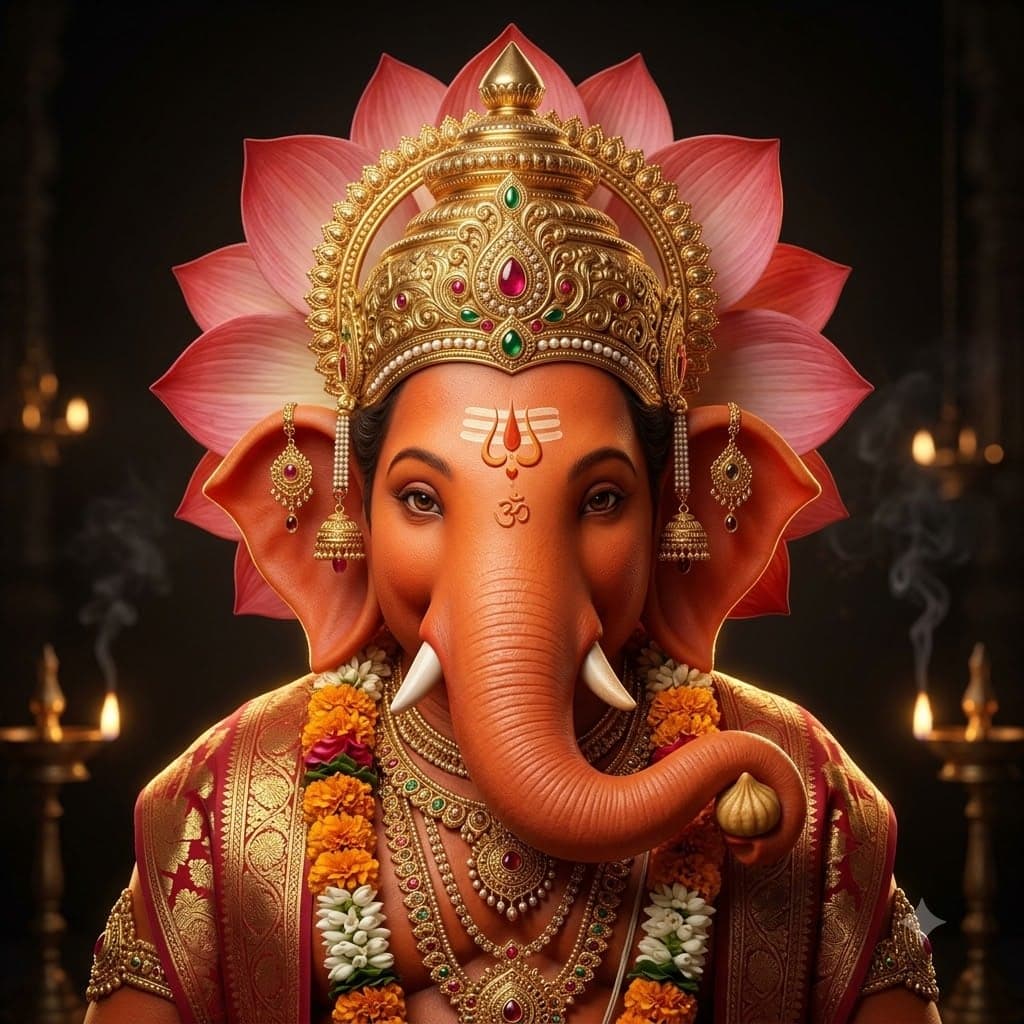
At a glance: Ganesh
- Also known as
- Ganesha, Ganapati, Vinayaka, Vighnaharta, Ekadanta, Gajanana, Lambodara, Vakratunda, Ganpati Bappa, Pillaiyar (Tamil Nadu)
- Family
- Son of Shiva and Parvati, brother of Kartikeya. Wives Siddhi and Buddhi (Shiva Purana), or Riddhi and Siddhi; sons Kshema (Shubh) and Labh. Many in South India hold him unmarried
- Shown with
- Elephant head with one tusk and a large belly; usually four arms holding a goad, a noose, a modak and his broken tusk or a lotus; red in colour; rides a mouse (mushak)
- Worshipped on
- Ganesh Chaturthi and Ganeshotsav, Ganesh Jayanti, monthly Sankashti and Vinayaki Chaturthi; Tuesday in Maharashtra, Wednesday in North India; worshipped first in every puja
- Holy places
- The Ashtavinayak: Morgaon, Siddhatek, Pali, Mahad, Theur, Lenyadri, Ozar, Ranjangaon; Siddhivinayak, Mumbai; Dagdusheth Halwai, Pune; Ganpatipule; Kanipakam
Siddhi and Buddhi in the Shiva Purana
The Shiva Purana tells the story of Ganesha’s marriage right after the famous contest between Shiva’s two sons (Rudra Samhita, Kumara Khanda 19). Shiva and Parvati said that whichever son first went round the whole earth would be married first (19.18), and Ganesha won by circling his parents seven times; that story is told in “Ganesha and Kartikeya: The Race Around the World”.
Prajapati Vishvarupa, the Purana says, had two daughters of divine beauty, Siddhi and Buddhi (Kumara Khanda 20.1–2). Shiva and Parvati joyfully celebrated Ganesha’s marriage to both of them, the gods attended, and Vishvakarma, the architect of the gods, made all the arrangements (20.3–5). Popular retellings often call the brides Vishvakarma’s daughters, but in the Shiva Purana their father is Vishvarupa and Vishvakarma only arranges the wedding.
In time Ganesha had a son by each wife: Kshema was born to Siddhi and Labha to Buddhi (20.7–8). The names carry meanings: Siddhi is success or accomplishment, Buddhi is intellect or wisdom, Kshema is welfare and security, and Labha is gain. So in the Shiva Purana the answer to “what are the names of Ganesha’s sons?” is Kshema and Labha.
Riddhi and Siddhi, Shubh and Labh in North India
In North India most people name Ganesha’s wives as Riddhi, prosperity, and Siddhi, success, and his sons as Shubh, auspiciousness, and Labh, gain. This is popular tradition: Shubh takes the place of the Shiva Purana’s Kshema, and Riddhi the place of Buddhi. The Shri Ganesh Chalisa, sung across North India, pictures Riddhi and Siddhi waving the fly-whisk over him: “ऋद्धि सिद्धि तव चँवर सुधारे”. Many families also read the “shubh” and “labh” written on either side of a swastika, on doorways and in new account books at Diwali’s Lakshmi Puja, as the names of Ganesha’s sons.
The pair Riddhi and Siddhi does appear in a Purana, though not as wives. The Skanda Purana says that Ganesha pulled out his own tusk to hold as a yogi’s staff and, “with the pair Riddhi and Siddhi”, still shone in his oneness (Maheshvara Khanda, Kedara Khanda 10.37: “ऋद्धिसिद्धिद्वयेनैव एकत्वेन विराजितः”). The Matsya Purana, describing how an image of Vinayaka should be made, places him “with Riddhi and Buddhi” and a mouse below (260.55). Neither text calls them his wives.
Other versions: the Ganesha Purana and Pushti
The Ganesha Purana, probably of the fourteenth or fifteenth century, was composed in Maharashtra, perhaps near the Ashtavinayak temples, its translator Greg Bailey argues. It tells two different stories. In one, at the beginning of creation, two radiant maidens appear by Ganesha’s own favour as gifts for his worship; Brahma offers them, and Ganesha takes Siddhi and Buddhi and vanishes (Upasana Khanda 15.33–39). In the other, Ganesha has swallowed a fire demon, and Brahma gives him two mind-born maidens, Siddhi and Buddhi, to cool the burning (65.9–18). The Purana’s meditation verse pictures Ganesha “constantly accompanied by Siddhi and Buddhi” as the giver of good fortune and intelligence (49).
The Devi Bhagavata Purana gives yet another name. Listing the goddesses who are parts of Prakriti, the Purana says that Pushti, nourishment, is the wife of Ganapati and is worshipped on earth: “पुष्टिर्गणपतेः पत्नी पूजिता जगतीतले” (9.1.101).
Ganesha the bachelor: South India and Bengal
Many in South India, especially in Tamil Nadu, where Ganesha is Pillaiyar, hold that Ganesha never married, and worship him as a brahmachari. That is a living popular tradition rather than the teaching of one text. Monier Monier-Williams, describing the worship of Ganesha and Subrahmanya he saw in South India, wrote in 1883 that unlike his brother Skanda, who has two wives, Devayani and Valli, Ganesha “is not generally represented as married” (Religious Thought and Life in India, p. 215). The Brahma Vaivarta Purana also shows a young Ganesha who turns marriage down: meditating by the Ganga, he refuses Tulasi’s proposal (Ganapati Khanda 46), the story told in “Why Is Tulsi Not Offered to Ganesha?”.
In Bengal a banana plant dressed in a sari like a new bride stands beside Ganesha through Durga Puja. She is called the Kola Bou, the “banana bride”, and many people take her to be Ganesha’s wife. The ritual manuals say otherwise: the priest binds nine plants, led by the plantain, into one sheaf, sets it to the right of the image on the seventh day and invites Durga herself to enter the sheaf, worshipping the plantain as the goddess Brahmani (P. V. Kane, History of Dharmaśāstra, vol. V, pp. 161–164). The Kola Bou, or Navapatrika, is the Goddess in plant form, not Ganesha’s bride.
Santoshi Maa, and what the wives mean
Santoshi Maa, the goddess of contentment, is often called Ganesha’s daughter, but no Purana says so. The scholar Philip Lutgendorf shows her worship spreading in northern India from the early 1960s through temples, posters and inexpensive vrat katha booklets, which name her the daughter of Ganesh and Riddhi-Siddhi. The 1975 film “Jai Santoshi Maa” made the story famous: it opens with Ganesha’s family celebrating Raksha Bandhan, his two little sons begging for a sister, and flames from his wives forming the child goddess (Manushi 131, 2002).
Scholars have long read Ganesha’s wives as his own powers. The art historian Alice Getty wrote in 1936 that “according to ancient tradition, Gaṇeśa was a Brahmacārin, that is, an unmarried deity”, that legend gave him two consorts personifying Wisdom and Success, and that ancient images never show them with him (Gaṇeśa, pp. 35–36). The texts point the same way: in the Skanda Purana Ganesha shines in his oneness though Riddhi and Siddhi are with him, and in the Ganesha Purana Siddhi and Buddhi appear by his own favour. Whichever names a family uses, the wives stand for what Ganesha gives his devotees, success, wisdom and prosperity, and the sons for welfare and gain.
In Maharashtra the Ganesha Purana of the Ganapatya tradition speaks of Siddhi and Buddhi, while “Shendur Lal Chadhayo”, the Hindi aarti sung at Ganpati aartis in Maharashtra, calls the eight siddhis Ganesha’s maidservants: “अष्टौ सिद्धी दासी”. Getty notes that the Shakta tradition worshipped these eight siddhis together as one goddess, the shakti of Ganesha (p. 36).
Aartis and bhajans of Ganesh
- Aala Majha Mumbaicha Raja
- Jhale Bhajan (Nirop Aarti) - Aamhi Namito Tav Charan
- Sukhkarta Dukhharta
- Lalbaugcha Raja (Song)
- Gajanana Ba Dayasagara
- Ghalin Lotangan Vandin Charan
- Jai Ganesh Jai Ganesh Deva
- Parvatichya Bala (Aala Re Aala Ganpati Aala)
Frequently asked questions
Who Are Ganesha’s Wives? Riddhi, Siddhi and Buddhi
Ganesha’s wives are Siddhi and Buddhi in the Shiva Purana, which names their sons Kshema and Labha; in North India they are called Riddhi and Siddhi, with sons Shubh and Labh. Many in South India hold Ganesha to be unmarried, and scholars read the wives as his own powers.
What are the other names of Ganesh?
Ganesha, Ganapati, Vinayaka, Vighnaharta, Ekadanta, Gajanana, Lambodara, Vakratunda, Ganpati Bappa, Pillaiyar (Tamil Nadu)
What other stories are told about Ganesh?
Why Does Ganesha Have an Elephant Head? What the Puranas Say; Why Is Ganesha’s Tusk Broken? The Story of Ekadanta; Why Is Tulsi Not Offered to Ganesha? The Story of Two Curses; Why Is the Mouse Ganesha’s Vahana? The Story of Mushaka; What Are the Ashtavinayak Temples? The Legend of Each Ganpati. Each is on Dharmasthan with its sources, in English, Hindi and Marathi.
Sources
- Shiva Purana, Rudra Samhita, Kumara Khanda, ch. 19–20 (J. L. Shastri tr.): The condition for the sons’ marriage (19.18); Siddhi and Buddhi, daughters of Prajapati Vishvarupa, marry Ganesha, Vishvakarma arranges the wedding, and their sons are Kshema and Labha (20.1–8) Read the text
- Skanda Purana, Maheshvara Khanda, Kedara Khanda, ch. 10 (G. V. Tagare tr.; Sanskrit checked on Wikisource): Ganesha holds his own tusk as a yogi’s staff, “with the pair Riddhi and Siddhi”, shining in his oneness (10.37) Read the text
- Matsya Purana 260.52–55 and Devi Bhagavata Purana 9.1.101 (Sanskrit text): The image of Vinayaka made with Riddhi and Buddhi and a mouse (Matsya 260.55); Pushti, the wife of Ganapati (Devi Bhagavata 9.1.101) Read the text
- Ganesha Purana, Upasana Khanda (Greg Bailey tr., 1995): Siddhi and Buddhi appear by Ganesha’s favour at creation (15.33–39); Brahma gives them to cool his fire (65.9–18); the meditation verse (49); the text’s date and likely Maharashtra origin (introduction) Read the text
- Alice Getty, Gaṇeśa: A Monograph on the Elephant-Faced God (Oxford, 1936), pp. 35–36; Monier Monier-Williams, Religious Thought and Life in India (London, 1883), pp. 214–215: Ganesha unmarried in ancient tradition, his consorts as personifications of Wisdom and Success, the eight siddhis as his shakti (Getty); Ganesha not generally shown married, unlike Skanda (Monier-Williams) Read the text
- Philip Lutgendorf, “A Superhit Goddess: Jai Santoshi Maa and Caste Hierarchy in Indian Films”, Manushi 131 (2002): Santoshi Maa’s worship from the early 1960s, the vrat booklets that call her the daughter of Ganesh and Riddhi-Siddhi, and the 1975 film’s birth scene Read the text
- P. V. Kane, History of Dharmaśāstra, vol. V part 1 (1958): Durga Puja: the sheaf of nine plants set to the right of the image, Durga invited into it, the plantain worshipped as Brahmani (pp. 161–164) Read the text