
Stories of Vishnu
Why Is Lord Jagannath’s Idol Incomplete? The Story and the Texts
By the Dharmasthan team · Updated · 7 sources cited
Lord Jagannath, the form of Vishnu worshipped as Krishna at Puri, has only stumps for arms because, in the legend told in Odisha, the queen had the carpenter’s door opened too soon. The Skanda Purana tells it differently: there the Lord himself finished the four wooden forms on the fifteenth day.
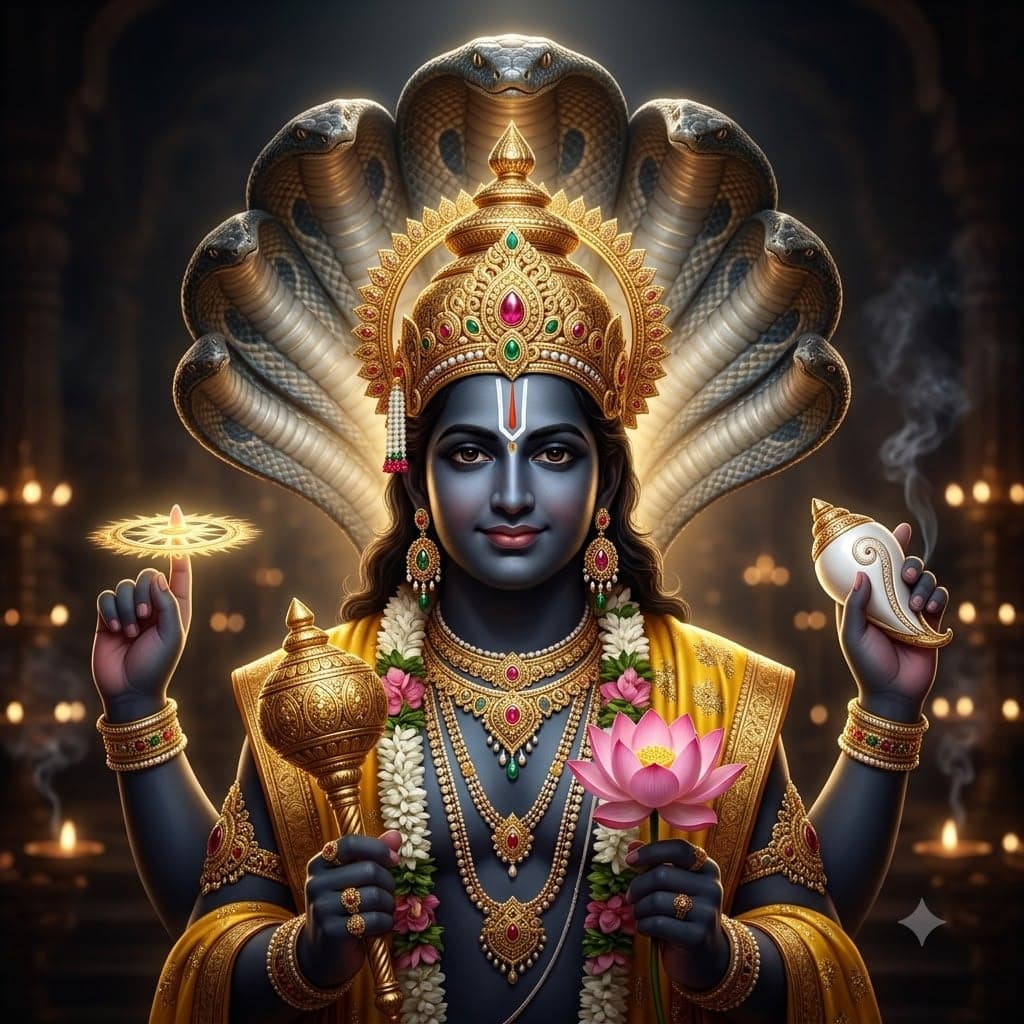
At a glance: Vishnu
- Also known as
- Narayana, Hari, Vasudeva, Keshava, Madhava, Govinda, Janardana, Padmanabha, Achyuta, Trivikrama, Purushottama, Lakshmipati
- Family
- Unborn in Vaishnava texts; the Shiva Purana has him arise from Shiva, the Mahabharata counts him youngest of Aditi’s twelve Adityas. Consort Lakshmi, with Bhudevi; Brahma is born from his navel lotus
- Shown with
- Dark blue, four arms holding the conch Panchajanya, the discus Sudarshana, the mace Kaumodaki and a lotus; Kaustubha jewel and Shrivatsa mark on the chest; rides Garuda; reclines on the serpent Shesha
- Worshipped on
- Every Ekadashi, above all Ashadhi and Kartiki; Anant Chaturdashi, Tulsi Vivah and the avatar jayantis; Thursday by popular custom; tulsi leaves, the Vishnu Sahasranama and “Om Namo Narayanaya”
- Holy places
- Tirumala (Venkateswara), Puri (Jagannath), Badrinath, Srirangam, Padmanabhaswamy in Thiruvananthapuram, Guruvayur and the 108 Divya Desams; in Maharashtra, Vitthal at Pandharpur
The legend told in Odisha
The best-known story is the one told in Odisha. King Indradyumna of Malava, a devotee of Vishnu, dreamt of Nila Madhava, a blue image of the Lord secretly worshipped in Odisha’s forests, and sent the Brahmin Vidyapati to find it. Vidyapati married Lalita, daughter of Vishvavasu, chief of the Shabara forest people, and was led to the shrine blindfold, dropping seeds to mark the way. When the king came, Nila Madhava had vanished, and a voice told him that the Lord would now take a body of wood.
A great log floated in from the sea, but no carpenter’s tools could cut it. Then an old carpenter offered to carve the images in twenty-one days, on condition that he work shut inside the temple with the door closed. After about two weeks the sounds inside stopped, and Queen Gundicha, fearing the old man had died, pressed the king to open the door. The carpenter was gone, and Jagannath, Balabhadra and Subhadra stood unfinished, with stumps for arms and no feet. The grieving king was told that the Lord wished to take this very form in the Kali age (M. N. Das, ed., Sidelights on History and Culture of Orissa, ch. 7).
Odia tellings of Jagannath’s story differ in detail. In some the old carpenter is Jagannath himself, in others Vishvakarma, the craftsman of the gods. In the Deula Tola, an Odia account of the temple, the queen peeps in; in the fifteenth-century Odia Mahabharata of Sarala Das, the king himself opens the door, fearing the silent carpenter is dead (A. Eschmann, in The Cult of Jagannath, ch. 5).
What the Puranas say
The Skanda Purana tells the story at length in its Purushottama-kshetra-mahatmya (Vaishnava Khanda), with a different ending. There King Indradyumna of Avanti hears of a sapphire image of Vasudeva at Puri, worshipped by the Shabara Vishvavasu, which a wind buries in golden sand before the king can see it (chapters 7–9). Later a great tree marked with the conch and discus floats to the shore (chapter 18).
In the Skanda Purana a voice from the sky orders the altar covered for fifteen days and an old carpenter let in behind shut doors; no one may enter or peep in, and the Lord himself will say when the work is done. The carpenter is Narayana in disguise (18.36–46). Nobody opens the door. “On the fifteenth day the Lord completed the work” (19.2–8): Janardana with the conch, discus, club and lotus, Balabhadra with seven serpent hoods, Subhadra as Lakshmi, and the Sudarshana discus as the fourth form (19.9–18). The king unveils them and sees Krishna with “long brawny arms” (19.35–41). In this telling the images are finished.
The Brahma Purana gives a third version. Vishnu and Vishvakarma come to the king as two Brahmins, and Vishvakarma carves Krishna, Balarama and Subhadra “in a trice”, their hands holding the discus and the ploughshare (Brahma Purana 47.25–57). In Akbar’s reign Abul Fazl recorded a fourth, which he counted among the popular fables of the shrine: the king was to guard a log washed up by the sea for seven days and enshrine whatever shape it took (Ain-i-Akbari, vol. II, Jarrett tr.).
Why the form is kept
Whichever version one follows, Puri has never “finished” Jagannath’s form. The Skanda Purana says the wooden images must never be seen as bare wood: they are to be covered with bark and cloth, painted (Vishnu dark as a rain cloud, Balabhadra white, Subhadra saffron, Sudarshana red) and redone every year (19.20–28). The Purana adds that the Lord will stay in his wooden body for a parardha, an immense age, and that neither the image nor the tree was made by anyone (31.43–59).
Puri renews Jagannath’s form through Nabakalebara, “the new body”. In a year with two months of Ashadha, usually twelve or nineteen years apart, new images are carved in the same shape from specially chosen neem trees, and the old ones are buried in the temple grounds. In other years only the outer layers of resin, sandalwood and cloth are renewed, after the Snana Yatra bath on Jyeshtha Purnima (G. C. Tripathi, in The Cult of Jagannath, ch. 13). The last Nabakalebara was held in 2015, nineteen years after 1996.
Devotees and historians read Jagannath’s form in different ways. In the Odia legend the Lord himself chose it. The form also echoes the Shvetashvatara Upanishad, which says of the Supreme Person: “Without foot or hand, he is swift and a seizer! He sees without eye; he hears without ear!” (3.19). Historians trace the unusual image to the wooden gods of Odisha’s forest peoples. The Skanda Purana itself reserves the anointing and dressing of the images for the descendants of Vishvavasu and of the king’s priest (19.29–34), and Puri’s Daita servitors are held to descend from those first Shabara worshippers (Eschmann, ch. 5).
The temple in history
The Indradyumna story is set in the Krita Yuga, the first age, but the present Jagannath temple dates from the twelfth century. Inscriptions of Anantavarman Chodaganga of the Eastern Ganga dynasty record gifts to Purushottama at Puri in the early 1130s, and historians date the start of the great temple to about 1135; whether he lived to see it finished is debated (H. von Stietencron, in The Cult of Jagannath, ch. 1). The same scholar dates the Skanda Purana’s Puri chapters to around 1300.
The Skanda Purana also describes the chariot festival, the Gundicha Yatra, in which the deities ride in three chariots of sixteen, fourteen and twelve wheels (chapter 33). Because Jagannath, Balabhadra and Subhadra are Krishna, his elder brother Balarama and their sister, Jagannath is worshipped as Krishna as well as Vishnu.
Maharashtra has its own chapter in the Jagannath temple’s history. The Bhonsles of Nagpur ruled Odisha from 1751 to 1803 and took over the temple’s administration; in 1768, when the East India Company asked for Odisha, Janoji Bhonsle’s first condition was that the temple and its pilgrim dues stay with the Marathas (H. Kulke, in The Cult of Jagannath).
Aartis and bhajans of Vishnu
- Shri Vishnu Sahasranama Stotram
- Om Jai Jagdish Hare
- Shri Vishnu Sahasranamavali (1,000 Names of Vishnu)
- Mangalam Bhagavan Vishnu
- Shantakaram Bhujagashayanam (Vishnu Dhyana)
- Om Namo Narayanaya (Ashtakshari)
- Om Namo Bhagavate Vasudevaya (Dvadashakshari)
- Vishnu / Narayan Gayatri Mantra
Frequently asked questions
Why Is Lord Jagannath’s Idol Incomplete? The Story and the Texts
Lord Jagannath, the form of Vishnu worshipped as Krishna at Puri, has only stumps for arms because, in the legend told in Odisha, the queen had the carpenter’s door opened too soon. The Skanda Purana tells it differently: there the Lord himself finished the four wooden forms on the fifteenth day.
What are the other names of Vishnu?
Narayana, Hari, Vasudeva, Keshava, Madhava, Govinda, Janardana, Padmanabha, Achyuta, Trivikrama, Purushottama, Lakshmipati
What other stories are told about Vishnu?
What Are the 10 Avatars of Vishnu? Names, Order and Sources; What Is the Story of Tirupati Balaji and His Debt to Kubera?; The Story of Samudra Manthan: Why Was the Ocean Churned?; Who Is Kalki, Vishnu’s Tenth Avatar, and When Will He Come?; How Was Lord Vishnu Born? What the Vedas and Puranas Say. Each is on Dharmasthan with its sources, in English, Hindi and Marathi.
Sources
- Skanda Purana, Vaishnava Khanda, Purushottama-kshetra-mahatmya, ch. 18 (G. V. Tagare tr.): The tree from the sea; the voice orders the doors shut for fifteen days; Narayana as the old carpenter (18.36–46) Read the text
- Skanda Purana, Vaishnava Khanda, Purushottama-kshetra-mahatmya, ch. 19: Work completed on the fifteenth day; the four forms; covering and painting; Vishvavasu’s descendants (19.2–41) Read the text
- Skanda Purana, Vaishnava Khanda, Purushottama-kshetra-mahatmya, ch. 7–9, 31, 33: Indradyumna, Vidyapati and the sapphire image; the Lord in the wooden body (31.43–59); the Gundicha Yatra Read the text
- Brahma Purana, ch. 47 (Motilal tr.): Vishnu and Vishvakarma as two Brahmins; the images made at once, hands holding discus and ploughshare (47.25–57) Read the text
- Abul Fazl, Ain-i-Akbari, vol. II, Sarkar of Katak (H. S. Jarrett tr., 2nd ed. rev. Jadunath Sarkar, 1949), pp. 139–140: Images of Krishna, his brother and sister; the log guarded for seven days, counted among “popular fables” Read the text
- A. Eschmann, H. Kulke and G. C. Tripathi (eds.), The Cult of Jagannath and the Regional Tradition of Orissa (1978): Odia versions (Deula Tola, Sarala Das); dating of the temple (Stietencron); Nabakalebara (Tripathi); Maratha rule (Kulke)
- M. N. Das (ed.), Sidelights on History and Culture of Orissa (1977), ch. 7 “History versus Legends”: The popular legend: Vidyapati and Lalita, the twenty-one days, the queen and the unfinished images Read the text