
Stories of Vishnu
How Was Lord Vishnu Born? What the Vedas and Puranas Say
By the Dharmasthan team · Updated · 7 sources cited
Lord Vishnu has no birth story in the Vedas, and the Vaishnava Puranas call him unborn and eternal: it is Brahma who is born, from the lotus in Vishnu’s navel. The Mahabharata counts Vishnu as the youngest of Aditi’s twelve sons, and the Shiva Purana says he arose from Shiva’s left side.
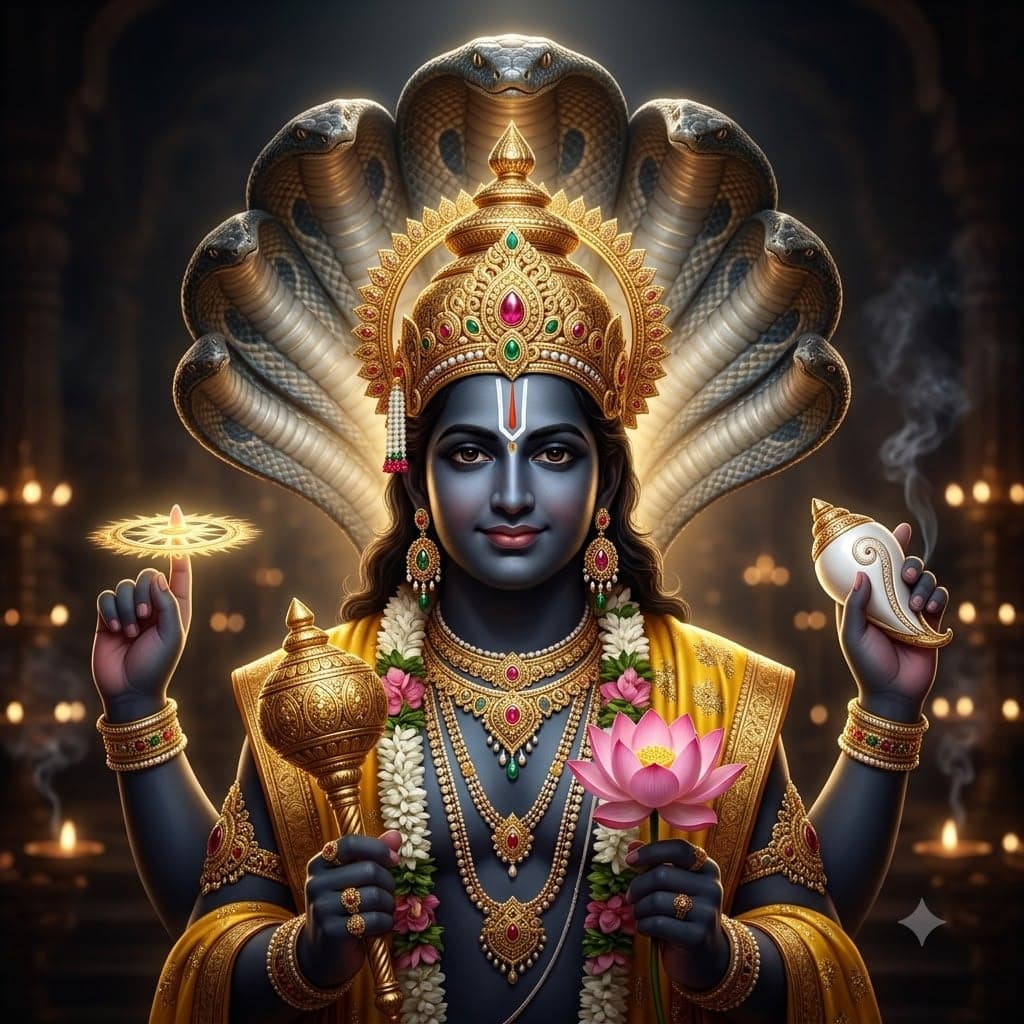
At a glance: Vishnu
- Also known as
- Narayana, Hari, Vasudeva, Keshava, Madhava, Govinda, Janardana, Padmanabha, Achyuta, Trivikrama, Purushottama, Lakshmipati
- Family
- Unborn in Vaishnava texts; the Shiva Purana has him arise from Shiva, the Mahabharata counts him youngest of Aditi’s twelve Adityas. Consort Lakshmi, with Bhudevi; Brahma is born from his navel lotus
- Shown with
- Dark blue, four arms holding the conch Panchajanya, the discus Sudarshana, the mace Kaumodaki and a lotus; Kaustubha jewel and Shrivatsa mark on the chest; rides Garuda; reclines on the serpent Shesha
- Worshipped on
- Every Ekadashi, above all Ashadhi and Kartiki; Anant Chaturdashi, Tulsi Vivah and the avatar jayantis; Thursday by popular custom; tulsi leaves, the Vishnu Sahasranama and “Om Namo Narayanaya”
- Holy places
- Tirumala (Venkateswara), Puri (Jagannath), Badrinath, Srirangam, Padmanabhaswamy in Thiruvananthapuram, Guruvayur and the 108 Divya Desams; in Maharashtra, Vitthal at Pandharpur
Vishnu in the Vedas: the three strides
The Rigveda, the oldest Hindu scripture, praises what Vishnu does rather than where he came from. Vishnu is the god of three great strides: he “made the three worlds”, alone upholds earth and heaven, and in his three paces all the worlds abide (Rigveda 1.154.1–4, H. H. Wilson’s translation). Another hymn says that the wise always behold Vishnu’s highest step: “tad viṣṇoḥ paramaṃ padaṃ sadā paśyanti sūrayaḥ” (1.22.20).
No Vedic hymn tells how Vishnu was born. One says that no one, born or being born, has reached the limit of Vishnu’s greatness (7.99.2); another speaks of praising “the great birth” of the mighty Vishnu without describing it (1.156.2). The Sanskritist A. A. Macdonell noted that the Rigveda’s only human traits for Vishnu are his strides and his form as a youth vast in body (Vedic Mythology, 1897, §17).
Son of Aditi: Vishnu among the Adityas
Vishnu first gets a family in the Mahabharata. The epic names the sage Kashyapa as the father of the gods and the asuras, and says that Aditi bore the twelve Adityas, “the lords of the universe”. Their list ends with Vishnu, the youngest, “upon whom the worlds depend”, greater in merit than all the others (Adi Parva, K. M. Ganguli’s sections 65–66).
The Rigveda does not count Vishnu among Aditi’s sons: its only list of Adityas names six gods, and Vishnu is not one of them. Only in later literature do the Adityas become twelve sun-gods, one for each month, with Vishnu the greatest of them (Macdonell, §19).
The Puranas tie this birth to an avatar. The Vishnu Purana says that in the present Manvantara Vishnu was born as Vamana, the son of Kashyapa and Aditi, who won the worlds with three paces (3.1). The Bhagavata tells how Vishnu agreed to become Aditi’s son (8.17.18; 8.18.1–12), a story told in full with Bali Pratipada. Vishnu’s birth from Aditi is a descent, not a beginning.
The unborn Lord of the Puranas
For the Vaishnava Puranas, Vishnu is never born at all. The Vishnu Purana bows to Vishnu as “unborn, imperishable, undecaying”, and says that the one god Janardana is called Brahma, Vishnu and Shiva as he creates, preserves and destroys the world (1.2).
In these texts the order of birth runs the other way: Brahma is born from Vishnu. The Bhagavata Purana pictures Vishnu lying on the serpent Ananta on the waters of dissolution; a lotus rises from his navel, and from it Brahma the creator appears (Bhagavata 1.3.2; 3.8.10–16). Brahma climbs down the stalk to find where the lotus comes from and never reaches its root (3.8.18–21). Hence Vishnu’s name Padmanabha, “lotus-navelled”.
Even Vishnu’s avatars are not births in the ordinary sense. In the Bhagavad Gita, Krishna says that though he is unborn and imperishable, he comes into being by his own power: “ajo ’pi sann avyayātmā” (4.6).
The Shiva Purana’s account
The popular claim that Vishnu was born from Shiva comes from the Shiva Purana (Rudra Samhita, Srishti Khanda, chapter 6), where Brahma tells the story to Narada. Before creation, Shiva and his Shakti wished for another being who would create, protect and dissolve the world. Shiva spread nectar, churned from the ocean of his own mind, “on His left side, on the tenth limb”, and a person arose: calm, full of sattva, shining like sapphire, with eyes like lotuses (6.32–39).
The new being bowed and asked Shiva for a name and a task. Shiva named him Vishnu “as you are all-pervasive”, gave him the Vedas through his breath and told him to perform penance (6.41–44). Vishnu did tapas for twelve thousand divine years; then streams of water flowed from his body and filled the void, and Vishnu lay down to sleep in them, which is why he is called Narayana (6.46–54).
The Shiva Purana goes on: a lotus grew from the sleeping Vishnu’s navel, and Shiva created Brahma from his right side and brought him forth through that lotus (7.1–5). These chapters are the basis of the popular saying that Vishnu came from Shiva’s left side and Brahma from his right. The quarrel between Brahma and Vishnu that follows, ended by the endless pillar of fire, belongs to Shiva’s own story.
Each tradition makes its own highest deity the source of the others. H. H. Wilson, the Vishnu Purana’s translator, noted that the Puranas all teach one supreme being who creates, preserves and destroys, and differ only in naming it: Vishnu in the Vishnu Purana, Shiva in the Linga, Krishna in the Brahma Vaivarta. The Shakta Devi Bhagavata has Vishnu lying as a child on a banyan leaf at the end of a kalpa, wondering who made him, until the Goddess answers that all this is she alone (1.15).
What the names Vishnu and Narayana mean
Tradition derives the name Vishnu from the Sanskrit root viś, “to enter” or “to pervade”. The Vishnu Purana says the deity is called Vishnu because his energy pervades the whole world (3.1), and the Shiva Purana gives the same reason when Shiva names him (Rudra Samhita, Srishti Khanda 6.43). Vishnu’s Rigvedic epithets urugaya and urukrama, “wide-going” and “wide-striding”, carry the same idea (Macdonell, §17).
The name Narayana is explained in the Manusmriti, “āpo nārā iti proktā āpo vai narasūnavaḥ”: the waters are called nārā because they are the offspring of Nara, the Supreme Being, and since the waters were his first resting place (ayana), he is called Narayana (Manusmriti 1.10). The Vishnu Purana repeats the verse for Vishnu (1.4), and the Bhagavata says the Supreme Person is Narayana because he lies on the waters that came from him (2.10.11). In the Mahabharata, the child whom the sage Markandeya sees on a banyan bough amid the flood of dissolution gives the same reason for his name (Vana Parva, Ganguli’s sections 187–188).
So the answer to “how was Vishnu born?” depends on the scripture: no birth in the Vedas, a mother in Aditi in the Mahabharata, no birth at all in the Vaishnava Puranas, and an origin in Shiva in the Shiva Purana. What they share is the picture his name Narayana keeps: Vishnu resting on the cosmic waters.
Aartis and bhajans of Vishnu
- Shri Vishnu Sahasranama Stotram
- Om Jai Jagdish Hare
- Shri Vishnu Sahasranamavali (1,000 Names of Vishnu)
- Mangalam Bhagavan Vishnu
- Shantakaram Bhujagashayanam (Vishnu Dhyana)
- Om Namo Narayanaya (Ashtakshari)
- Om Namo Bhagavate Vasudevaya (Dvadashakshari)
- Vishnu / Narayan Gayatri Mantra
Frequently asked questions
How Was Lord Vishnu Born? What the Vedas and Puranas Say
Lord Vishnu has no birth story in the Vedas, and the Vaishnava Puranas call him unborn and eternal: it is Brahma who is born, from the lotus in Vishnu’s navel. The Mahabharata counts Vishnu as the youngest of Aditi’s twelve sons, and the Shiva Purana says he arose from Shiva’s left side.
What are the other names of Vishnu?
Narayana, Hari, Vasudeva, Keshava, Madhava, Govinda, Janardana, Padmanabha, Achyuta, Trivikrama, Purushottama, Lakshmipati
What other stories are told about Vishnu?
What Are the 10 Avatars of Vishnu? Names, Order and Sources; What Is the Story of Tirupati Balaji and His Debt to Kubera?; The Story of Samudra Manthan: Why Was the Ocean Churned?; Why Is Lord Jagannath’s Idol Incomplete? The Story and the Texts; Who Is Kalki, Vishnu’s Tenth Avatar, and When Will He Come?. Each is on Dharmasthan with its sources, in English, Hindi and Marathi.
Sources
- Rigveda 1.22.16–21, 1.154, 1.156.2 and 7.99.2 (H. H. Wilson tr., with Sayana’s commentary): Vishnu’s three strides and highest step; no one has reached the limit of his greatness; “the great birth” praised but not told Read the text
- A. A. Macdonell, Vedic Mythology (Strassburg, 1897), §17 Vishnu and §19 Adityas: Vishnu’s small place and only human traits in the Rigveda; its one list of six Adityas; twelve Adityas in later literature, Vishnu the greatest Read the text
- Mahabharata, Adi Parva, sections 65–66; Vana Parva, sections 187–188 (K. M. Ganguli tr.): Vishnu the youngest of Aditi’s twelve Adityas; Markandeya’s vision of the child on the banyan, who explains the name Narayana Read the text
- Vishnu Purana 1.2, 1.4 and 3.1 (H. H. Wilson tr.): Vishnu unborn and undecaying, one god named Brahma, Vishnu and Shiva, with Wilson’s note on the Puranas; the Narayana verse; Vamana son of Aditi and the meaning of “Vishnu” Read the text
- Bhagavata Purana 1.3.2, 2.10.11, 3.8.10–21 and 8.17–18: Brahma born from the lotus of Vishnu’s navel; Narayana as the one who lies on the waters; Vishnu born of Aditi as Vamana Read the text
- Shiva Purana, Rudra Samhita, Srishti Khanda, ch. 6–7 (J. L. Shastri tr.): Vishnu arises from nectar on Shiva’s left side and is named Vishnu and Narayana (6.32–54); Brahma from Shiva’s right side through Vishnu’s navel lotus (7.1–5) Read the text
- Manusmriti 1.10 (Ganganath Jha tr., with Medhatithi’s commentary): The waters are nārā, his first abode, hence the name Narayana Read the text