
Stories of Vishnu
What Are the 10 Avatars of Vishnu? Names, Order and Sources
By the Dharmasthan team · Updated · 7 sources cited
The ten avatars of Vishnu, the Dashavatara, are Matsya, Kurma, Varaha, Narasimha, Vamana, Parashurama, Rama, Krishna (or Balarama), the Buddha and Kalki. The Agni Purana tells them in this order, but other lists differ: the Mahabharata counts Hamsa, the swan, and the Bhagavata names 22 avatars.
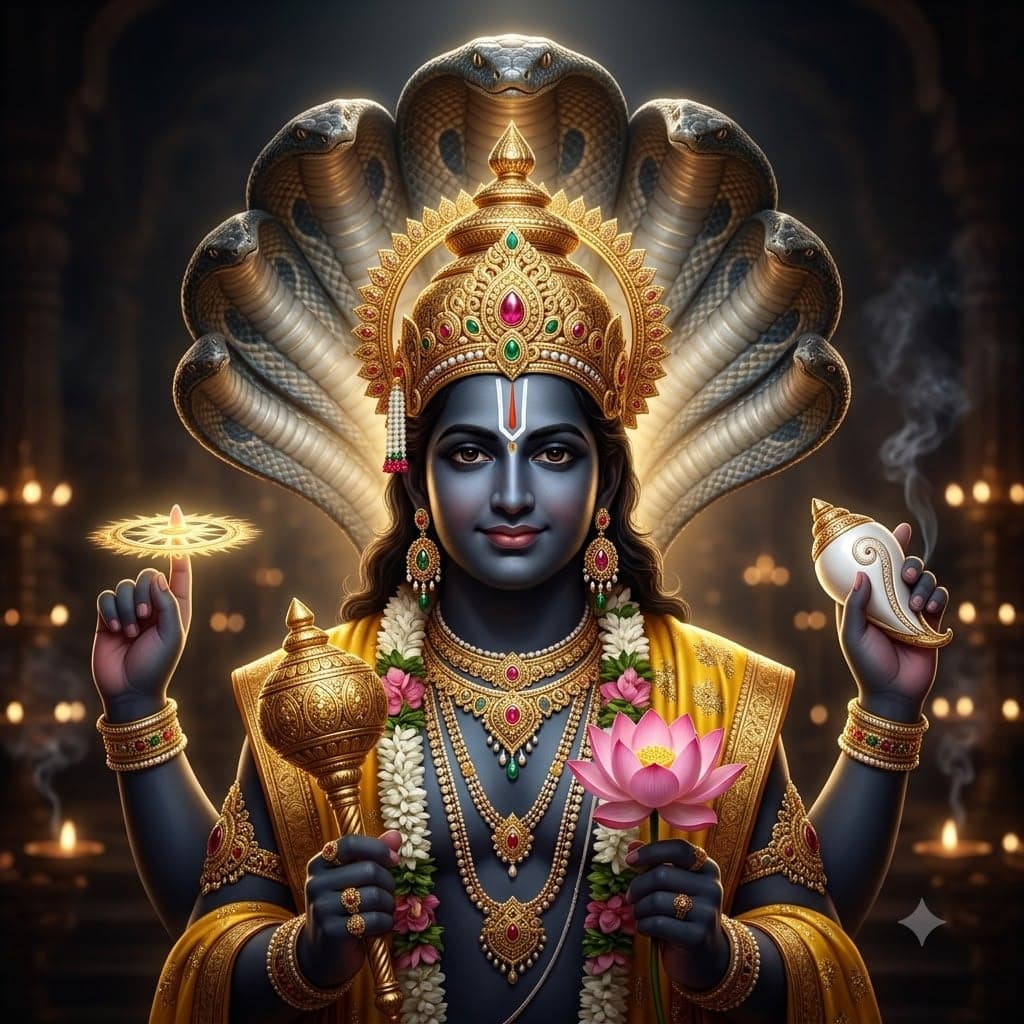
At a glance: Vishnu
- Also known as
- Narayana, Hari, Vasudeva, Keshava, Madhava, Govinda, Janardana, Padmanabha, Achyuta, Trivikrama, Purushottama, Lakshmipati
- Family
- Unborn in Vaishnava texts; the Shiva Purana has him arise from Shiva, the Mahabharata counts him youngest of Aditi’s twelve Adityas. Consort Lakshmi, with Bhudevi; Brahma is born from his navel lotus
- Shown with
- Dark blue, four arms holding the conch Panchajanya, the discus Sudarshana, the mace Kaumodaki and a lotus; Kaustubha jewel and Shrivatsa mark on the chest; rides Garuda; reclines on the serpent Shesha
- Worshipped on
- Every Ekadashi, above all Ashadhi and Kartiki; Anant Chaturdashi, Tulsi Vivah and the avatar jayantis; Thursday by popular custom; tulsi leaves, the Vishnu Sahasranama and “Om Namo Narayanaya”
- Holy places
- Tirumala (Venkateswara), Puri (Jagannath), Badrinath, Srirangam, Padmanabhaswamy in Thiruvananthapuram, Guruvayur and the 108 Divya Desams; in Maharashtra, Vitthal at Pandharpur
The ten avatars of Vishnu, in order
Most lists give Vishnu’s ten avatars, the Dashavatara, in this order: Matsya the fish, Kurma the tortoise, Varaha the boar, Narasimha the man-lion, Vamana the dwarf, Parashurama, Rama, Krishna (or Balarama), the Buddha and Kalki. The Agni Purana tells them in this sequence, from the fish in chapter 2 to the Buddha and Kalki in chapter 16, and says the avatars come “for the destruction of the wicked and for the protection of the pious” (2.2).
In the Bhagavata Purana, Matsya keeps Manu’s boat afloat in the great flood (1.3.15), Kurma bears Mount Mandara on his back when the ocean is churned (1.3.16), and Varaha lifts the earth from the depths (1.3.7). Narasimha, half man and half lion, tears apart the demon king Hiranyakashipu (1.3.18), the story behind Holika Dahan. Vishnu’s page tells each story in full, the tortoise with the churning of the ocean.
Vamana, the fifth avatar, is the dwarf brahmin boy who asked King Bali for three steps of land (Bhagavata Purana 1.3.19). Vamana’s story has deep roots: the Rigveda already praises Vishnu as the god who measured the worlds in three strides (1.154.1–3). The full story of Vamana and Bali is told with Diwali Padwa, Bali Pratipada, the day Maharashtra remembers King Bali.
Parashurama, the sixth, is the Bhargava warrior who rid the earth of kshatriyas twenty-one times (Bhagavata Purana 1.3.20); his story is on Vishnu’s page and his jayanti falls on Akshaya Tritiya. Rama, the seventh, crossed the ocean and killed Ravana (1.3.22), and Krishna is the eighth; both have their own deity pages.
The Buddha is the ninth avatar in many Hindu lists. The Bhagavata Purana says that when the Kali age begins, “Buddha, the son of Anjana” will appear among the Kikatas to bewilder the enemies of the gods (1.3.24); the Agni Purana instead makes him the son of Shuddhodana (16.2). Buddhists generally reject the idea: the fifth of the vows Dr B. R. Ambedkar gave at Deekshabhoomi in Nagpur in 1956 denies that the Buddha was an incarnation of Vishnu. The Buddha Purnima story tells the Buddha’s life as Buddhists understand it.
Kalki, the tenth avatar, is still to come. The Bhagavata Purana says Kalki will be born as the son of Vishnuyasha at the junction of two ages, when kings have become plunderers (1.3.25), and the Agni Purana says a new Krita age follows his work (16.8–10). Kalki’s own story tells what the texts say about his coming.
The earliest lists, and how they differ
One of the oldest lists of ten is in the Mahabharata. In the Narayaniya of the Shanti Parva, Narayana tells the sage Narada that he will appear as “a swan, a tortoise, a fish”, then as a boar, a man-lion, a dwarf, Rama of Bhrigu’s race, Rama the son of Dasharatha, Krishna of the Satvata clan, “and lastly as Kalki” (Ganguli’s translation, section 340). This list has Hamsa, the swan, where later lists have the Buddha.
The Bhagavata Purana does not stop at ten. Its first book names twenty-two avatars, among them the four Kumaras, Kapila, Dattatreya, Dhanvantari, Mohini and Vyasa, and counts Balarama and Krishna together as the nineteenth and twentieth (1.3.6–25). It then says Hari’s avatars are countless (1.3.26) and that all of them are portions of the Lord, “but Krishna is Bhagavan himself” (1.3.28). Its second book gives another list, with the horse-headed Hayagriva (2.7.11), but no total: no verse of the Bhagavata gives the popular count of twenty-four.
Jayadeva’s twelfth-century Gita Govinda opens with the song “Pralaya payodhi jale”, in which Balarama is the eighth avatar and the Buddha the ninth, praised for condemning animal sacrifice out of compassion (1.5–14); the verse after the song bows to Krishna, who took all ten forms (1.16). A Pallava-period inscription in the Adivaraha cave at Mamallapuram, which scholars call the oldest list of the ten in stone, names three Ramas, Parashurama, Rama and Balarama, with the Buddha and Kalki, and leaves out Krishna.
Why Vishnu takes avatars
The best-known reason for Vishnu’s avatars comes from Krishna in the Bhagavad Gita: whenever dharma declines, the Lord comes in every age to protect the good, destroy the wicked and re-establish dharma (4.7–8).
The Matsya Purana traces Vishnu’s human births to a curse. In a war with the gods, the asuras took refuge with Bhrigu’s wife, the mother of Shukra, and when she threatened to burn Indra and Vishnu by the power of her austerities, Vishnu cut off her head (Matsya Purana 47.97–103; Devi Bhagavata Purana 4.11.37–55). Bhrigu cursed him: because he had knowingly killed a woman, he would be born among men seven times (Matsya Purana 47.104–105). So, the Purana says, whenever dharma declines, Vishnu is born among men for the good of the world (47.106). The Devi Bhagavata tells the same curse without the number seven (4.12.8–9).
Many people today read Vishnu’s ten avatars as a ladder of evolution, from fish and tortoise to boar, man-lion, dwarf and then full human beings. That is a modern interpretation, first put forward in the nineteenth century, not a reading the Puranas themselves give.
The Dashavatara in Maharashtra
At Ellora, Cave 15 is known as the Dashavatara cave, “the cave of ten incarnations of Vishnu”. It bears a fourteen-line inscription praising the Rashtrakuta king Dantidurga, dated to about 753 CE, according to the Archaeological Survey of India.
In the Konkan and Goa, Dashavatar is a living folk theatre, said to be at least five hundred years old. All-male troupes, many of them farmers and labourers, tour Sindhudurg, Ratnagiri and north Goa from about October to May, after the paddy harvest, playing at village temple jatras from midnight until dawn. A performance opens with a devotional prelude in which a masked Ganesha enters, and then plays out the akhyan, the night’s story drawn from Vishnu’s avatars.
In 1843 the missionary scholar J. Stevenson reported that in Maharashtra the devotees of Vitthal of Pandharpur considered their god “the ninth or Bauddha Avatar of Vishnu”, putting Vitthal in the Buddha’s place (Journal of the Royal Asiatic Society, vol. 7). Vitthal’s own page tells his story.
Aartis and bhajans of Vishnu
- Shri Vishnu Sahasranama Stotram
- Om Jai Jagdish Hare
- Shri Vishnu Sahasranamavali (1,000 Names of Vishnu)
- Mangalam Bhagavan Vishnu
- Shantakaram Bhujagashayanam (Vishnu Dhyana)
- Om Namo Narayanaya (Ashtakshari)
- Om Namo Bhagavate Vasudevaya (Dvadashakshari)
- Vishnu / Narayan Gayatri Mantra
Frequently asked questions
What Are the 10 Avatars of Vishnu? Names, Order and Sources
The ten avatars of Vishnu, the Dashavatara, are Matsya, Kurma, Varaha, Narasimha, Vamana, Parashurama, Rama, Krishna (or Balarama), the Buddha and Kalki. The Agni Purana tells them in this order, but other lists differ: the Mahabharata counts Hamsa, the swan, and the Bhagavata names 22 avatars.
What are the other names of Vishnu?
Narayana, Hari, Vasudeva, Keshava, Madhava, Govinda, Janardana, Padmanabha, Achyuta, Trivikrama, Purushottama, Lakshmipati
What other stories are told about Vishnu?
What Is the Story of Tirupati Balaji and His Debt to Kubera?; The Story of Samudra Manthan: Why Was the Ocean Churned?; Why Is Lord Jagannath’s Idol Incomplete? The Story and the Texts; Who Is Kalki, Vishnu’s Tenth Avatar, and When Will He Come?; How Was Lord Vishnu Born? What the Vedas and Puranas Say. Each is on Dharmasthan with its sources, in English, Hindi and Marathi.
Sources
- Mahabharata, Shanti Parva, Narayaniya (K. M. Ganguli tr., section 340): Narayana’s list of ten forms: swan, tortoise, fish, boar, man-lion, dwarf, the two Ramas, Krishna and Kalki Read the text
- Bhagavata Purana 1.3 and 2.7: The twenty-two avatars (1.3.6–25), the Buddha (1.3.24), Kalki (1.3.25), avatars countless (1.3.26), “kṛṣṇas tu bhagavān svayam” (1.3.28); a second list with Hayagriva and no total (2.7) Read the text
- Agni Purana, ch. 2–16 (N. Gangadharan tr.): The ten told in order: fish (2), tortoise (3), boar, man-lion, dwarf and Parashurama (4), Rama (5–11), Krishna (12), Buddha and Kalki (16) Read the text
- Jayadeva, Gita Govinda 1.5–16 (B. Stoler Miller ed., GRETIL): The Dashavatara song “pralaya-payodhi-jale”, with Balarama eighth and the Buddha ninth, ending in homage to Krishna Read the text
- Matsya Purana 47.97–107; Devi Bhagavata Purana 4.11–12 (Swami Vijnanananda tr.): Vishnu kills Shukra’s mother and Bhrigu curses him to be born among men, “seven times” in the Matsya Purana (47.105) Read the text
- Adivaraha cave inscription, Mamallapuram (DHARMA edition by Emmanuel Francis): “matsyaḥ kūrmo varāhaś ca …”: three Ramas, the Buddha and Kalki, without Krishna; the oldest list of the ten in stone Read the text
- Indrajit Khambe, “A rich night of Dashavatar improvisations”, PARI, 8 May 2018; P. W. Pandit and M. K. Mishra, “Reframing Dashavatar”, Critical Stages 33 (2026): Konkan and Goa Dashavatar theatre: season, jatras, all-male troupes, the purvaranga and the akhyan Read the text