
Stories of Vishnu
The Story of Samudra Manthan: Why Was the Ocean Churned?
By the Dharmasthan team · Updated · 7 sources cited
The gods and asuras churned the ocean of milk for amrit, the nectar of immortality: Vishnu planned it, held Mount Mandara on his back as the tortoise Kurma and, as Mohini, kept the amrit for the gods. Why they needed it and what rose differ from text to text; the fourteen ratnas are a later popular count.
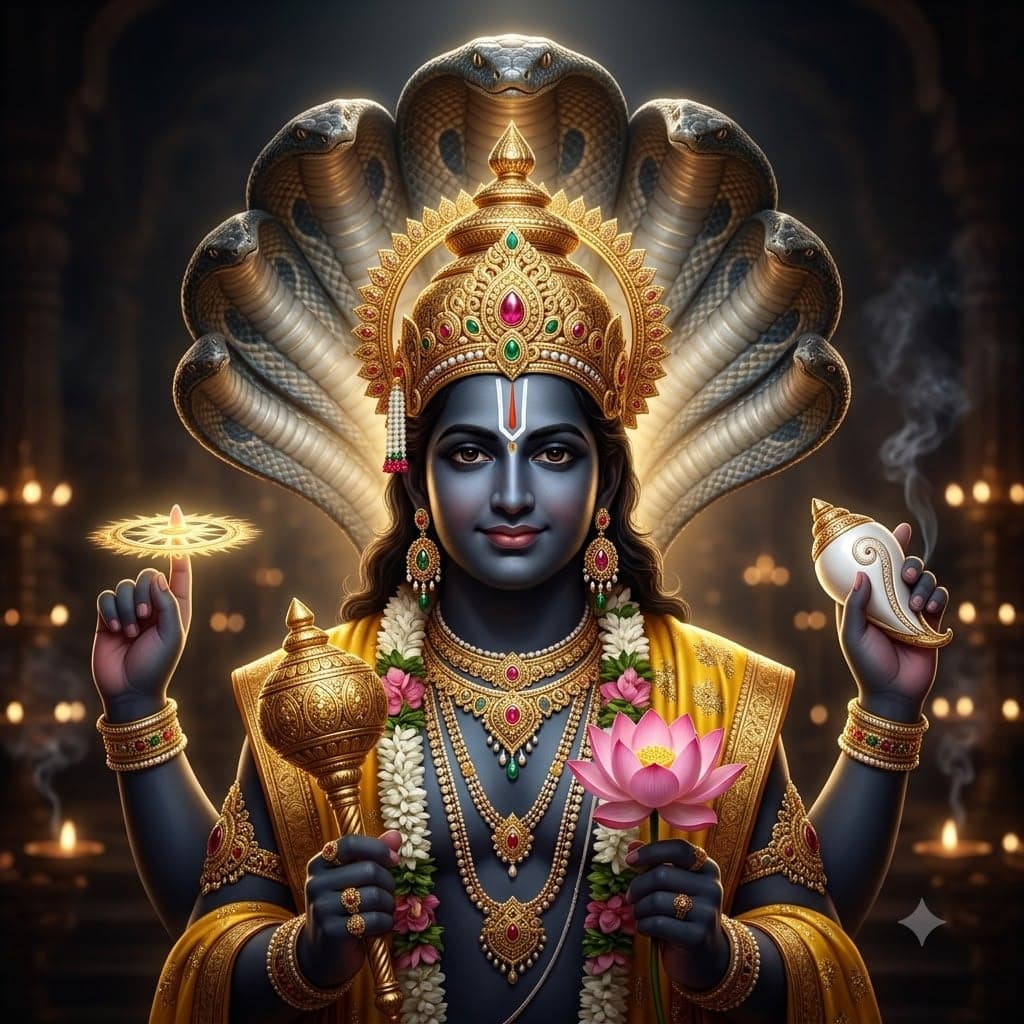
At a glance: Vishnu
- Also known as
- Narayana, Hari, Vasudeva, Keshava, Madhava, Govinda, Janardana, Padmanabha, Achyuta, Trivikrama, Purushottama, Lakshmipati
- Family
- Unborn in Vaishnava texts; the Shiva Purana has him arise from Shiva, the Mahabharata counts him youngest of Aditi’s twelve Adityas. Consort Lakshmi, with Bhudevi; Brahma is born from his navel lotus
- Shown with
- Dark blue, four arms holding the conch Panchajanya, the discus Sudarshana, the mace Kaumodaki and a lotus; Kaustubha jewel and Shrivatsa mark on the chest; rides Garuda; reclines on the serpent Shesha
- Worshipped on
- Every Ekadashi, above all Ashadhi and Kartiki; Anant Chaturdashi, Tulsi Vivah and the avatar jayantis; Thursday by popular custom; tulsi leaves, the Vishnu Sahasranama and “Om Namo Narayanaya”
- Holy places
- Tirumala (Venkateswara), Puri (Jagannath), Badrinath, Srirangam, Padmanabhaswamy in Thiruvananthapuram, Guruvayur and the 108 Divya Desams; in Maharashtra, Vitthal at Pandharpur
Why the ocean was churned
The Vishnu Purana traces the churning to a curse (Book 1, chapter 9). Indra put a garland from the sage Durvasa on his elephant, which threw it down, and Durvasa cursed him to lose his rule over the three worlds (1.9.2–17), as told in full in “Why Did Lakshmi Leave Heaven?”. The worlds lost their splendour, the daityas defeated the weakened gods, and the gods went with Brahma to Vishnu at the ocean of milk (1.9.26–37).
Vishnu told the gods to make a truce with the daityas, throw healing herbs into the ocean of milk and churn it, with Mount Mandara as the rod and the serpent Vasuki as the rope. The daityas were to be promised an equal share, but the amrit would go to the gods alone (Vishnu Purana 1.9.76–79). In the Bhagavata Purana, Vishnu also warns that a poison will rise first and that the gods must not be greedy for the treasures (8.6.19–25).
The Bhagavata mentions Durvasa’s curse only in passing (8.5.15–16). The Mahabharata and the Ramayana have no curse: gods and asuras simply want amrit and freedom from old age and death (Adi Parva, Ganguli section 17; Bala Kanda 1.45.15–18). H. H. Wilson, who translated the Vishnu Purana in 1840, judged Durvasa’s part a later embellishment.
Kurma: Vishnu holds up the mountain
The Bhagavata Purana tells the churning most fully (Canto 8, chapters 6–9). The gods and asuras uprooted Mandara, a mountain of gold, and Vishnu carried it to the ocean on Garuda (8.6.33–38). When the asuras refused the serpent’s tail as beneath them, Vishnu smiled and took the tail with the gods (8.7.1–4).
With nothing beneath it, Mandara sank (8.7.6–7). Then Vishnu took the form of a tortoise, entered the water and lifted the mountain on his back, which spread out like a great island (8.7.8–9). This is the Kurma avatar, second in the familiar list of ten. Vishnu also appeared on the summit with a thousand arms, holding the mountain steady (8.7.12).
The Vishnu Purana and the Ramayana also make the tortoise Vishnu. In the Vishnu Purana, Hari as a tortoise is the pivot on which Mandara turns (1.9.86). In the Ramayana the mountain sinks to the netherworld and Hrishikesha, as a tortoise, lies in the ocean bearing it on his back (Bala Kanda 1.45.27–29).
The Mahabharata tells it differently: the gods and asuras ask Akupara, king of tortoises, to support the mountain, and Indra sets it on his back (Adi Parva, Ganguli section 18). This passage never calls the tortoise Vishnu. Local tradition at Bounsi, in Bihar’s Banka district, holds its Mandar hill to be the churning mountain.
What rose from the ocean: the fourteen ratnas
In the Bhagavata the churning first brought up the halahala poison, which Shiva drank to save the worlds (8.7.18–43), as “Why Is Shiva Called Neelkanth?” tells. Then came the cow Surabhi, the white horse Uchchaihshravas, the four-tusked elephant Airavata, the Kaustubha jewel for Vishnu’s chest, the Parijata tree and the apsaras (8.8.1–7).
Next rose Lakshmi, who chose Vishnu (8.8.8–25), as told in “How Was Goddess Lakshmi Born?”. Then came Varuni, goddess of wine, and last Dhanvantari, physician of the gods and a portion of Vishnu, with a jar of amrit (8.8.30–35).
The other texts differ. The Vishnu Purana has Surabhi, Varuni, the Parijata, the apsaras, the moon, which Shiva took, the poison, which the nagas took, Dhanvantari and, last, Shri (1.9.90–98); the Bhagavata has no moon. The Mahabharata begins with the moon and ends with the poison (Adi Parva, Ganguli section 18), and the Ramayana names the poison, Dhanvantari, the apsaras, Varuni, Uchchaihshravas, the Kaustubha and the amrit (Bala Kanda 1.45.20–38).
The famous fourteen ratnas (chaudah ratna) are a popular count, not a list found in these texts. Wilson noted that the Ramayana and the Mahabharata name nine treasures, the Bhagavata ten and the Vayu Purana twelve, and that popular lists reach fourteen by adding items such as Vishnu’s conch and bow, for which he found no good authority (note to Vishnu Purana 1.9).
Mohini and the amrit
The asuras snatched the jar from Dhanvantari and quarrelled over who would drink first (Bhagavata 8.8.35–40). Vishnu then took the form of Mohini, a woman of such beauty that every asura wanted her (8.8.41–46). The asuras gave her the jar, promising to accept whatever she did, and Mohini seated gods and asuras in separate rows and poured the amrit for the gods alone (8.9.11–21).
Rahu, disguised as a god, drank too, but the Sun and the Moon recognised him and Vishnu cut off his head with his discus (8.9.24–26), as “How Were Rahu and Ketu Born?” tells. Vishnu then showed his own form, and the gods won the battle that followed (8.9.27; chapters 10–11). The Bhagavata draws a lesson: the effort was the same on both sides, but only the gods, who had taken refuge in Vishnu, gained the amrit (8.9.28).
Every telling has Vishnu win back the amrit in a woman’s form. The Vishnu Purana gives it a single verse (1.9.107), the Mahabharata calls her an enchantress (Adi Parva, Ganguli section 19), and in the Ramayana Vishnu takes the amrit by a bewitching illusion, māyām āsthāya mohinīm (Bala Kanda 1.45.41). Mohini’s other famous story, with Bhasmasura, is told among Shiva’s stories.
The Kumbh Mela and the churning today
Many people link the churning to the Kumbh Mela: as the jar was carried off, the story goes, drops of amrit fell at Prayagraj, Haridwar, Ujjain and Nashik. That is popular tradition, with Mohini, Dhanvantari, Garuda or Indra as the bearer. None of the tellings above mentions drops falling anywhere, and historians of the Kumbh Mela, following D. P. Dubey, regard the four drops as a later addition.
In Maharashtra the Kumbh is the Simhastha of Nashik and Trimbakeshwar, held on the Godavari every twelve years, when Jupiter is in Simha (Leo). The present Simhastha opened with the raising of flags at Ramkund and Trimbakeshwar on 31 October 2026; its main bathing days, the Amrit Snan, fall on 2 August, 31 August and 11 September 2027. At Diwali, too, families remember the churning: Dhanvantari on Dhanteras and Lakshmi at Lakshmi Puja.
Festivals of this story
Aartis and bhajans of Vishnu
- Shri Vishnu Sahasranama Stotram
- Om Jai Jagdish Hare
- Shri Vishnu Sahasranamavali (1,000 Names of Vishnu)
- Mangalam Bhagavan Vishnu
- Shantakaram Bhujagashayanam (Vishnu Dhyana)
- Om Namo Narayanaya (Ashtakshari)
- Om Namo Bhagavate Vasudevaya (Dvadashakshari)
- Vishnu / Narayan Gayatri Mantra
Frequently asked questions
The Story of Samudra Manthan: Why Was the Ocean Churned?
The gods and asuras churned the ocean of milk for amrit, the nectar of immortality: Vishnu planned it, held Mount Mandara on his back as the tortoise Kurma and, as Mohini, kept the amrit for the gods. Why they needed it and what rose differ from text to text; the fourteen ratnas are a later popular count.
What are the other names of Vishnu?
Narayana, Hari, Vasudeva, Keshava, Madhava, Govinda, Janardana, Padmanabha, Achyuta, Trivikrama, Purushottama, Lakshmipati
What other stories are told about Vishnu?
What Are the 10 Avatars of Vishnu? Names, Order and Sources; What Is the Story of Tirupati Balaji and His Debt to Kubera?; Why Is Lord Jagannath’s Idol Incomplete? The Story and the Texts; Who Is Kalki, Vishnu’s Tenth Avatar, and When Will He Come?; How Was Lord Vishnu Born? What the Vedas and Puranas Say. Each is on Dharmasthan with its sources, in English, Hindi and Marathi.
Sources
- Vishnu Purana, Book 1, ch. 9 (McComas Taylor tr.): Durvasa’s curse (vv. 2–17); Vishnu’s plan (76–79); Hari as the tortoise (86); the treasures, with the moon and Shri (90–98); Vishnu in a female form recovers the amrit (106–107) Read the text
- Vishnu Purana, Book 1, ch. 9 (H. H. Wilson tr., 1840), with Wilson’s notes: Durvasa absent from the Ramayana and Mahabharata versions; the popular count of fourteen treasures against nine, ten or twelve in the texts, made up with Vishnu’s conch and bow Read the text
- Bhagavata Purana, Canto 8, ch. 5–7: Durvasa’s curse alluded to (8.5.15–16); Vishnu’s plan (8.6.19–25); Mandara carried on Garuda (8.6.33–38); Vasuki and Vishnu as the tortoise (8.7.1–12); the halahala (8.7.18–43) Read the text
- Bhagavata Purana, Canto 8, ch. 8–9: The treasures from Surabhi to Dhanvantari (8.8.1–35); Mohini (8.8.41–46); the amrit given to the gods, Rahu, and the lesson (8.9.11–28) Read the text
- Mahabharata, Adi Parva, Astika Parva, sections 17–19 (K. M. Ganguli tr.): Narayana proposes the churning; Akupara, king of tortoises, holds up Mandara (1.16.10 in the Sanskrit critical text); the order of the treasures; Vishnu as an enchantress; Rahu Read the text
- Valmiki Ramayana, Bala Kanda, sarga 45 (IIT Kanpur Valmiki Ramayana): The wish to be free of old age and death (1.45.15–18); the treasures (20–38); Vishnu as the tortoise (27–29); Vishnu takes the amrit by a bewitching illusion (41) Read the text
- Deccan Chronicle, 31 October 2026: Flags raised at Ramkund and Trimbakeshwar to open the Nashik–Trimbakeshwar Simhastha; the Amrit Snan dates in 2027 Read the text