
Stories of Vishnu
Who Is Kalki, Vishnu’s Tenth Avatar, and When Will He Come?
By the Dharmasthan team · Updated · 7 sources cited
Kalki is the tenth and last avatar of Vishnu, the one still to come. The Bhagavata Purana says he will be born in Shambhala to a brahmin named Vishnuyasha at the end of the Kali age, ride the horse Devadatta, sword in hand, and bring back the Satya age. No scripture gives a calendar date.
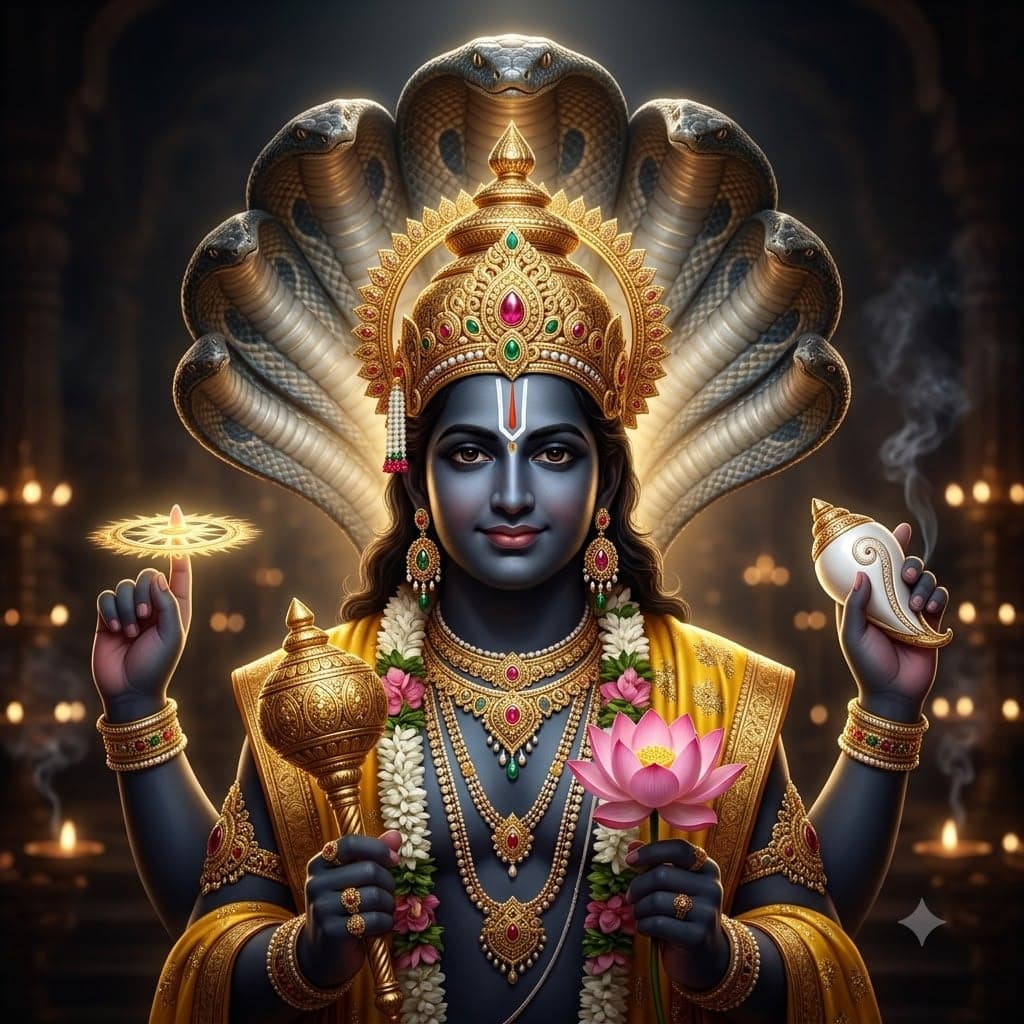
At a glance: Vishnu
- Also known as
- Narayana, Hari, Vasudeva, Keshava, Madhava, Govinda, Janardana, Padmanabha, Achyuta, Trivikrama, Purushottama, Lakshmipati
- Family
- Unborn in Vaishnava texts; the Shiva Purana has him arise from Shiva, the Mahabharata counts him youngest of Aditi’s twelve Adityas. Consort Lakshmi, with Bhudevi; Brahma is born from his navel lotus
- Shown with
- Dark blue, four arms holding the conch Panchajanya, the discus Sudarshana, the mace Kaumodaki and a lotus; Kaustubha jewel and Shrivatsa mark on the chest; rides Garuda; reclines on the serpent Shesha
- Worshipped on
- Every Ekadashi, above all Ashadhi and Kartiki; Anant Chaturdashi, Tulsi Vivah and the avatar jayantis; Thursday by popular custom; tulsi leaves, the Vishnu Sahasranama and “Om Namo Narayanaya”
- Holy places
- Tirumala (Venkateswara), Puri (Jagannath), Badrinath, Srirangam, Padmanabhaswamy in Thiruvananthapuram, Guruvayur and the 108 Divya Desams; in Maharashtra, Vitthal at Pandharpur
Kalki in the Bhagavata Purana
Kalki is the tenth and last of Vishnu’s ten avatars, the Dashavatara, and the only one still to come. The Bhagavata Purana names him at the end of its list of avatars: at the meeting of two ages, when kings have sunk almost to robbery, the Lord of the world will be born as Kalki, the son of Vishnuyasha (1.3.25). Its twelfth book tells more. Vishnu takes birth to protect dharma (12.2.17), and Kalki will appear in the home of the foremost brahmin of the village of Shambhala, the great-souled Vishnuyasha (12.2.18).
Kalki, the Bhagavata goes on, will mount the swift horse Devadatta and, sword in hand and endowed with eight divine powers, ride across the earth in matchless splendour, killing by the millions the robbers who dress as kings (12.2.19–20). Popular pictures show the horse white; the Bhagavata gives no colour.
When the false kings are gone, breezes carrying the fragrance of Vasudeva’s sandal paste will make people’s minds pure, Vasudeva will appear in their hearts, and the survivors will fill the earth again (12.2.21–22). When the moon, the sun and Jupiter enter one sign together with the lunar mansion Tishya, that is Pushya, the Satya or Krita age begins (12.2.24).
The Vishnu Purana and Mahabharata versions
The Vishnu Purana tells the story at the close of its list of the kings of the Kali age (4.24). When Vedic practice has almost ceased and the end of Kali is near, a portion of the Supreme will descend and be born as Kalki in the family of Vishnuyashas, an eminent brahmin of the village of Sambhala, with the eight superhuman powers. Kalki will destroy the mlecchas, the thieves and all who are bent on wrongdoing. The minds of those alive at the end of the age will be awakened, “as pellucid as crystal” in Wilson’s translation, and they will be the seed of a new humanity living by the ways of the Krita age.
The earliest telling is usually taken to be the Mahabharata’s, in the sage Markandeya’s account of the ages to Yudhishthira (Vana Parva 3.188–189 in the critical edition of Pune’s Bhandarkar Institute; Ganguli’s sections 189–190). Here Vishnuyasha is not Kalki’s father: the verse names the brahmin himself Kalki Vishnuyasha (3.188.89). Impelled by Time, he is born in a brahmin home in the village of Sambhala; vehicles, weapons, warriors and armour come to him as soon as he thinks of them, and he becomes a world-ruler who conquers by dharma (3.188.90–91). Having rid the earth of robbers, he gives it to the brahmins at a great horse sacrifice, restores the bounds set by the Creator and, grown old, retires to the forest (3.189.1–2).
That Vana Parva passage does not call Kalki an avatar. The link is made in the Narayaniya of the Shanti Parva, where Narayana lists the forms he will take, from the swan, the tortoise and the fish to Rama and Krishna, “and lastly as Kalki” (Ganguli’s section 340). The Agni Purana adds that the sage Yajnavalkya will be Kalki’s priest (16.8–9), and that afterwards Hari will lay aside the form of Kalki and the Krita age will return (16.10).
When will Kalki come?
The texts’ answer is plain: Kalki comes at the end of the Kali age, and no scripture gives a year or a date. The Bhagavata says the Kali age began on the day Krishna left the world (12.2.29–33) and lasts twelve hundred years of the gods (12.2.31). The Vishnu Purana agrees on both (4.24).
In the Vishnu Purana a divine year is 360 human years, and Kali is 1,000 divine years with a twilight of 100 at each end (1.3). That works out to the 432,000 human years usually quoted for the Kali age; in 4.24 the same Purana gives 360,000 years, the count without the twilights. Indian astronomers, following the reckoning in Aryabhata’s Aryabhatiya of 499 CE, count the Kali age from 3102 BCE (Aryabhatiya 3.10). On that traditional count about 5,100 years have passed and more than 426,000 remain.
The sign the texts give for the turn of the ages, the sun, moon and Jupiter together with Pushya, is not a timetable. Jupiter takes about twelve years to circle the zodiac, so such a meeting comes round roughly every twelve years; the scriptures give it as the mark of the new age, not as a date to work out. Dates that circulate online, and claims that Kalki has already been born, do not come from these texts.
The Kalki Purana and later traditions
Much of what popular retellings add comes from the Kalki Purana, a minor Purana (upapurana), some of whose colophons present it as a sequel to the Bhagavata about things to come. The historian Ludo Rocher judged that the Kalki Purana probably comes from Bengal and was composed at a relatively recent date; one manuscript he cites is dated 1804 (The Purāṇas, 1986, pp. 183–184).
In the Kalki Purana, Vishnu promises Brahma he will be born in Shambhala to Vishnuyasha and his wife Sumati, and the child is born on the twelfth day of the bright half of Vaishakha (1.2). Parashurama, who in the Bhagavata still lives on Mount Mahendra (9.16.26), teaches him the Vedas and archery, and Shiva gives him a horse born of Garuda, an all-knowing parrot and a jewel-hilted sword (1.3). Kalki marries Padmavati, princess of Simhala, defeats Kali, inaugurates the Krita age from Shambhala and at the end returns to heaven.
The rest is tradition. Some identify Shambhala with Sambhal in Uttar Pradesh, near Moradabad, which has an old Shri Kalki Vishnu temple, and in 2024 the foundation stone of a new Shri Kalki Dham was laid in Sambhal district. In Jaipur, a Kalki temple built under Sawai Jai Singh II in the eighteenth century stands opposite the City Palace gate in Sireh Deori Bazaar, with a white marble horse in its courtyard. Panchangs such as Drik Panchang mark Kalki Jayanti on Shravana Shukla Shashthi, while the Kalki Purana gives the twelfth of Vaishakha’s bright half: a jayanti that remembers a birth the scriptures still place in the future.
Aartis and bhajans of Vishnu
- Shri Vishnu Sahasranama Stotram
- Om Jai Jagdish Hare
- Shri Vishnu Sahasranamavali (1,000 Names of Vishnu)
- Mangalam Bhagavan Vishnu
- Shantakaram Bhujagashayanam (Vishnu Dhyana)
- Om Namo Narayanaya (Ashtakshari)
- Om Namo Bhagavate Vasudevaya (Dvadashakshari)
- Vishnu / Narayan Gayatri Mantra
Frequently asked questions
Who Is Kalki, Vishnu’s Tenth Avatar, and When Will He Come?
Kalki is the tenth and last avatar of Vishnu, the one still to come. The Bhagavata Purana says he will be born in Shambhala to a brahmin named Vishnuyasha at the end of the Kali age, ride the horse Devadatta, sword in hand, and bring back the Satya age. No scripture gives a calendar date.
What are the other names of Vishnu?
Narayana, Hari, Vasudeva, Keshava, Madhava, Govinda, Janardana, Padmanabha, Achyuta, Trivikrama, Purushottama, Lakshmipati
What other stories are told about Vishnu?
What Are the 10 Avatars of Vishnu? Names, Order and Sources; What Is the Story of Tirupati Balaji and His Debt to Kubera?; The Story of Samudra Manthan: Why Was the Ocean Churned?; Why Is Lord Jagannath’s Idol Incomplete? The Story and the Texts; How Was Lord Vishnu Born? What the Vedas and Puranas Say. Each is on Dharmasthan with its sources, in English, Hindi and Marathi.
Sources
- Bhagavata Purana 1.3, 9.16 and 12.2 (Bhaktivedanta tr.): Kalki son of Vishnuyasha (1.3.25); Shambhala, the horse Devadatta, the sword and the return of the Satya age (12.2.17–24); Kali of 1,200 divine years from Krishna’s departure (12.2.29–34); Parashurama on Mahendra (9.16.26) Read the text
- Vishnu Purana 1.3 and 4.24 (H. H. Wilson tr., 1840): Kalki born in the family of Vishnuyashas of Sambhala at the close of the Kali age (4.24); the lengths of the ages and their twilights in divine years (1.3) Read the text
- Mahabharata, Vana Parva 3.188–189 (critical ed.; Ganguli tr. sections 189–190) and Shanti Parva, Narayaniya (Ganguli section 340): Markandeya foretells Kalki Vishnuyasha of Sambhala, the horse sacrifice and the Krita age; Narayana’s list of his forms ending with Kalki Read the text
- Agni Purana, ch. 16 (N. Gangadharan tr.): Kalki son of Vishnuyashas with Yajnavalkya as priest (16.8–9); Hari lays aside the Kalki form and the Krita age returns (16.10)
- Kalki Purana, amsha 1, ch. 2–3 (tr. Bhumipati Das): Birth to Vishnuyasha and Sumati on Vaishakha Shukla Dvadashi; Parashurama as teacher; Shiva’s gifts of horse, parrot and sword
- Ludo Rocher, The Purāṇas (A History of Indian Literature II.3, 1986), pp. 111, 183–184: Kalki as Vishnu’s one future avatar; the Kalki Purana’s contents, its Bengal origin, recent date and an 1804 manuscript
- Aryabhatiya 3.10 (W. E. Clark tr., 1930), pp. 54–55: The astronomers’ Kali era beginning in 3102 BCE Read the text