
Stories of Vishnu
What Is the Story of Tirupati Balaji and His Debt to Kubera?
By the Dharmasthan team · Updated · 7 sources cited
Tirupati Balaji is Venkateswara, Vishnu as worshipped on the Tirumala hill, who married the princess Padmavati. The Skanda Purana tells the wedding with Kubera giving, not lending; Bhrigu’s kick, Lakshmi leaving for Kolhapur and the Kubera loan come from the Tirumala temple tradition.
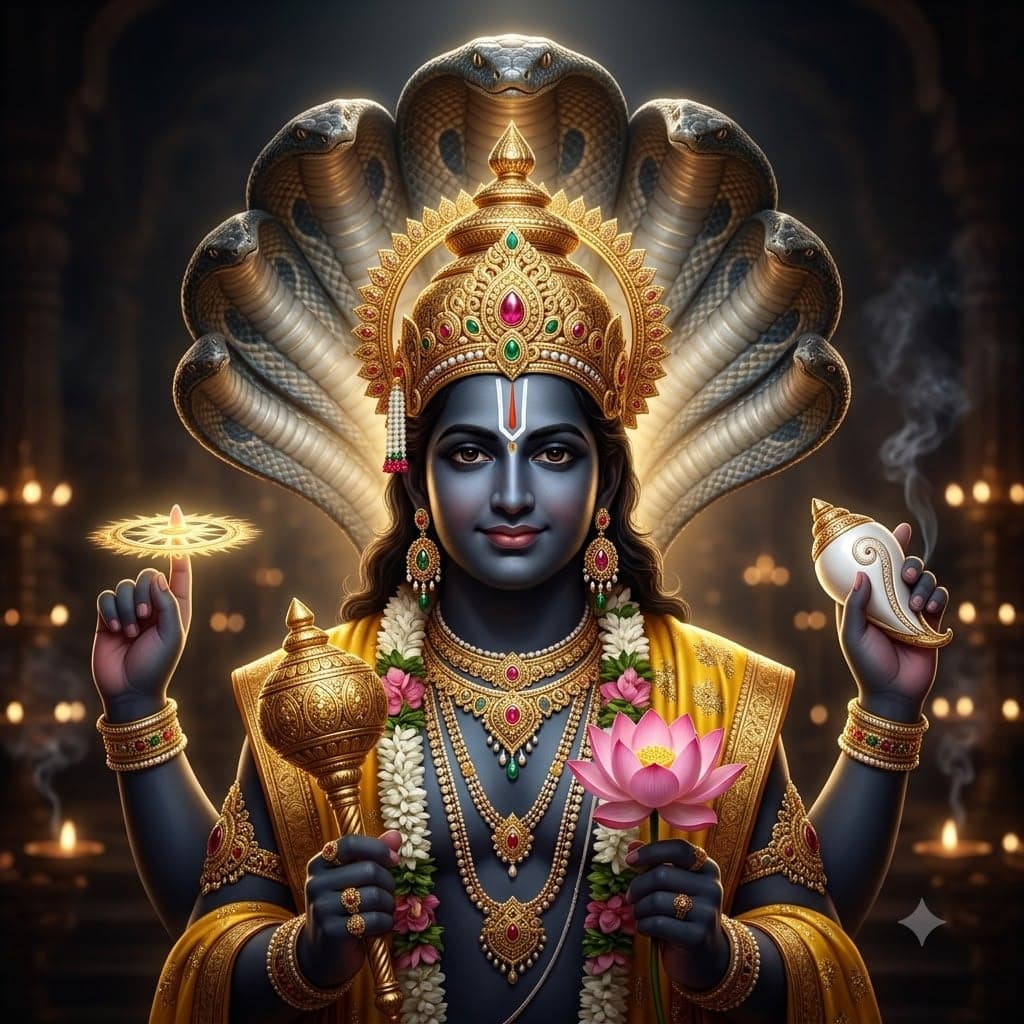
At a glance: Vishnu
- Also known as
- Narayana, Hari, Vasudeva, Keshava, Madhava, Govinda, Janardana, Padmanabha, Achyuta, Trivikrama, Purushottama, Lakshmipati
- Family
- Unborn in Vaishnava texts; the Shiva Purana has him arise from Shiva, the Mahabharata counts him youngest of Aditi’s twelve Adityas. Consort Lakshmi, with Bhudevi; Brahma is born from his navel lotus
- Shown with
- Dark blue, four arms holding the conch Panchajanya, the discus Sudarshana, the mace Kaumodaki and a lotus; Kaustubha jewel and Shrivatsa mark on the chest; rides Garuda; reclines on the serpent Shesha
- Worshipped on
- Every Ekadashi, above all Ashadhi and Kartiki; Anant Chaturdashi, Tulsi Vivah and the avatar jayantis; Thursday by popular custom; tulsi leaves, the Vishnu Sahasranama and “Om Namo Narayanaya”
- Holy places
- Tirumala (Venkateswara), Puri (Jagannath), Badrinath, Srirangam, Padmanabhaswamy in Thiruvananthapuram, Guruvayur and the 108 Divya Desams; in Maharashtra, Vitthal at Pandharpur
Who is Venkateswara?
Venkateswara means “Lord of Venkata”, the hill at Tirumala above the town of Tirupati in Andhra Pradesh, home to one of India’s most visited temples. Devotees also call Venkateswara Shrinivasa (“abode of Shri”, that is, Lakshmi), Govinda and, across North India and Maharashtra, Balaji. The main Puranic account of the hill is the Venkatachala-mahatmya of the Skanda Purana (Vaishnava Khanda). It says the hill had a name in each age: Anjanadri in the Krita age, Narayanagiri in the Treta, Simha in the Dvapara and Venkatachala in the Kali age (1.59–61).
In the Skanda Purana, Venkateswara is not the hill’s first lord. Vishnu as Varaha, the boar who lifted the Earth from the waters, comes to the hill with the Earth goddess and stays on the western bank of the Swami Pushkarini tank, while Shrinivasa dwells on its southern bank (Venkatachala-mahatmya 1.53, 1.93–96). Tirumala’s temple tradition adds that Shrinivasa asked Varaha for the land and promised him the first worship, which is why offerings at Tirumala still go first to Varaha. Vishnu’s Varaha avatar has its own story.
Padmavati’s wedding, as the Skanda Purana tells it
The Skanda Purana tells Venkateswara’s wedding in chapters 3 to 8 of the Venkatachala-mahatmya, chapters its translator says closely follow the Varaha Purana. King Akasha of Narayanapura, ploughing ground on the Arani river for a sacrifice, finds a baby girl lying on lotuses and raises her as his daughter Padmini, or Padmavati (3.21–28, 4.3). When she is grown, Narada reads her palm and says her face is fit for Vishnu (4.9–20). One spring day Shrinivasa, riding a white horse after a wolf, sees her in a flower garden and calls himself the lord of heroes who lives on Venkatadri (4.29–52).
Back on the hill, Shrinivasa tells his attendant Bakulamalika who the girl is. In the Rama story she was Vedavati, who took Sita’s place as Ravana’s captive in Lanka; Sita herself asked Rama to marry her, and he promised to do so in the twenty-eighth Kali age (5.18–30). Bakulamalika carries the proposal to Queen Dharani, Brihaspati fixes the wedding for Vaishakha, and the gods prepare King Akasha’s city: Kubera, the lord of wealth, fills it with riches and grain (7.6–54).
Lakshmi herself bathes and adorns Shrinivasa for the wedding, then rides with him on Garuda to King Akasha’s city, with Brahma, Shiva, Varuna, Yama and Kubera in the procession (8.1–15). Bride and groom exchange garlands three times, and Brahma performs the rites, from tying the mangalsutra to the offering of parched grain, over four days (8.20–26). Shrinivasa returns to the hill and sits enthroned with Lakshmi and Padmavati together; King Akasha gives lavish gifts and asks only for lasting devotion (8.27–40). In this account nothing is borrowed: Kubera gives.
Bhrigu’s kick and the Kubera loan: scripture and temple tradition
The Bhagavata Purana tells of Bhrigu’s kick with no link to Tirumala (10.89.1–17). Sages at a sacrifice on the Sarasvati river ask which of the three gods is greatest and send Bhrigu to test them. Bhrigu kicks Vishnu on the chest as he lies with his head on Lakshmi’s lap. Vishnu and Lakshmi rise to honour the sage, and Vishnu asks his pardon, saying Lakshmi will now consent to dwell on his chest (10.89.8–11). In the Bhagavata, Lakshmi does not leave.
Most devotees know the Tirumala tradition, as told by the temple’s trust, Tirumala Tirupati Devasthanams (TTD). Lakshmi, angry that the kick fell on her own abode, leaves Vaikuntha for Karavirapura, today’s Kolhapur, home of the Mahalakshmi temple whose story is told under Lakshmi. Searching for her, Vishnu settles in an ant-hill under a tamarind tree beside the Pushkarini. Brahma and Shiva become a cow and calf to feed him, a Chola king’s cowherd swings an axe at the cow, and Vishnu takes the blow. The king, cursed, is born again as Akasha, and Vakula Devi, Yashoda reborn, becomes Shrinivasa’s foster-mother.
The Skanda Purana has a different form of the ant-hill. A hunter chases a white boar into it, and the Lord, through the hunter, asks King Tondaman to bathe the ant-hill with the milk of a black cow, naming the tamarind tree his own abode and the champaka Lakshmi’s (10.6–47). The cowherd’s axe and the loan are not there.
In TTD’s telling, Shrinivasa, “according to mythologies”, takes a huge loan from Kubera for the wedding. Six months later Lakshmi arrives, Shrinivasa turns to stone, and both goddesses stay with him, Lakshmi on the left of his chest and Padmavati on the right. Devotees commonly say their offerings help Venkateswara repay the debt until the end of the Kali age: a popular belief, not a scriptural rule. The loan is usually traced to the Bhavishyottara Purana, one of the sources TTD lists, which could not be checked here; it is in neither the Skanda Purana chapters nor the Bhagavata.
Tirumala in history and worship today
The Tamil epic Silappadikaram describes Vishnu standing on the crest of Vengadam with discus and conch (Book 11, lines 41–51). The Alvars, the Tamil Vaishnava poet-saints whose four thousand verses praise Vishnu’s 108 sacred shrines, sang of Tiruvengadam; the historian S. Krishnaswami Aiyangar placed their hymns broadly between 300 and 800 CE.
An inscription records that a lady named Samavai, titled Kadavan Perundevi, gave a silver image of “the god standing at Vengadam”, with jewels and land for its festivals. TTD identifies it as the Bhoga Shrinivasa image and dates the gift to 614 CE; Aiyangar read the record as belonging to the reign of a tenth-century Chola prince. In the early twelfth century the Vaishnava teacher Ramanuja answered Shaiva claims on the shrine and restored its Vaikhanasa ritual, as the Venkatachala Itihasamala relates; inscriptions of the next century name his flower garden.
Pilgrims keep vows such as climbing the hill on foot from Alipiri and offering their hair at the Kalyana Katta tonsure halls, a temple custom described by TTD. The wedding is re-enacted daily as the Kalyanotsavam, and Padmavati has her own temple at Tiruchanur below the hills. In Maharashtra the god is known simply as Balaji, a name these Skanda Purana chapters do not use.
Aartis and bhajans of Vishnu
- Shri Vishnu Sahasranama Stotram
- Om Jai Jagdish Hare
- Shri Vishnu Sahasranamavali (1,000 Names of Vishnu)
- Mangalam Bhagavan Vishnu
- Shantakaram Bhujagashayanam (Vishnu Dhyana)
- Om Namo Narayanaya (Ashtakshari)
- Om Namo Bhagavate Vasudevaya (Dvadashakshari)
- Vishnu / Narayan Gayatri Mantra
Frequently asked questions
What Is the Story of Tirupati Balaji and His Debt to Kubera?
Tirupati Balaji is Venkateswara, Vishnu as worshipped on the Tirumala hill, who married the princess Padmavati. The Skanda Purana tells the wedding with Kubera giving, not lending; Bhrigu’s kick, Lakshmi leaving for Kolhapur and the Kubera loan come from the Tirumala temple tradition.
What are the other names of Vishnu?
Narayana, Hari, Vasudeva, Keshava, Madhava, Govinda, Janardana, Padmanabha, Achyuta, Trivikrama, Purushottama, Lakshmipati
What other stories are told about Vishnu?
What Are the 10 Avatars of Vishnu? Names, Order and Sources; The Story of Samudra Manthan: Why Was the Ocean Churned?; Why Is Lord Jagannath’s Idol Incomplete? The Story and the Texts; Who Is Kalki, Vishnu’s Tenth Avatar, and When Will He Come?; How Was Lord Vishnu Born? What the Vedas and Puranas Say. Each is on Dharmasthan with its sources, in English, Hindi and Marathi.
Sources
- Skanda Purana, Vaishnava Khanda, Venkatachala-mahatmya, ch. 1 (G. V. Tagare tr.): Varaha on the western bank of the Swami Pushkarini, Shrinivasa on the southern (1.53, 1.93–96); the hill’s names in the four ages (1.59–61) Read the text
- Skanda Purana, Vaishnava Khanda, Venkatachala-mahatmya, ch. 3–5: Padmavati found in the ploughed field (3.21–28), Narada reads her palm (4.9–20), the hunt (4.29–52), Vedavati (5.18–30); the translator’s note that these chapters follow the Varaha Purana Read the text
- Skanda Purana, Vaishnava Khanda, Venkatachala-mahatmya, ch. 7–8: Kubera fills King Akasha’s city with wealth (7.54); Lakshmi adorns Shrinivasa, Brahma performs the wedding, Akasha’s gifts and boon (8.1–40); no loan Read the text
- Skanda Purana, Vaishnava Khanda, Venkatachala-mahatmya, ch. 10: The white boar and the ant-hill, King Tondaman, the tamarind and champaka trees (10.6–47) Read the text
- Bhagavata Purana 10.89: Bhrigu tests the three gods and kicks Vishnu; Lakshmi stays on his chest (vv. 1–17) Read the text
- Tirumala Tirupati Devasthanams, “Temple Legend” and “Temple History” (official website): The Tirumala telling: Lakshmi at Karavirapura (Kolhapur), the ant-hill and the cow, Vakula Devi, the Kubera loan; first worship to Varaha; the Bhoga Shrinivasa dated 614; the daily Kalyanotsavam Read the text
- S. Krishnaswami Aiyangar, A History of Tirupati, vol. 1 (TTD Committee, Madras, 1940): The Alvars and the Silappadikaram (pp. 52–53, 96–97); Samavai’s silver image dated to a Chola prince’s reign (pp. 231–232); Ramanuja’s arrangements (pp. 288–291) Read the text